

Literature Management and the Impact of AI in Drug Safety
When a pharmaceutical company markets a drug, the safety monitoring journey is just beginning. Every week, pharmacovigilance(PV) teams must screen thousands of scientific publications from databases like PubMed and EMBASE, searching for adverse drug reactions that could signal emerging safety concerns.
The problem is that even if the PV team misses finding one critical case report, it can put patients at risk. On the flip side, when the same case appears across multiple journals and gets counted twice, regulatory authorities might see false signals that trigger unnecessary investigations.
At this point, literature monitoring is becoming both a regulatory mandate and a significant operational challenge. However, artificial intelligence is changing how drug safety teams handle this workload. In this article, we will look at the specific challenges PV teams face in literature monitoring, various approaches to solve these problems, and how AI-powered solutions are improving outcomes. So, let’s get started.
The Literature Monitoring Challenge in Pharmacovigilance
PV teams operate under clear regulatory requirements. The EMA’s Good Pharmacovigilance Practices Module VI and FDA guidance require companies to conduct systematic literature surveillance at least weekly. This includes searching major journals, global and local databases, conference abstracts, regulatory websites, and ahead-of-print articles. But the scale of this task is significant.
- PubMed contains over 30 million citations, and EMBASE indexes more than 36 million records.
- Research shows that literature screening takes up to 70% of pharmacovigilance team time.
This means PV professionals spend most of their week on screening tasks rather than on medical and scientific analysis.
Regulatory inspections add another layer of complexity. Inspectors review documentation of every search such as:
- Which databases were queried
- What terms were used
- How inclusion or exclusion decisions were made
Organizations need to maintain complete records of this process and missing any single documentation can lead to Warning Letters and corrective action plans.
Common Approaches For Literature Monitoring Challenges
The most common approach to make literature monitoring more manageable is as follows:
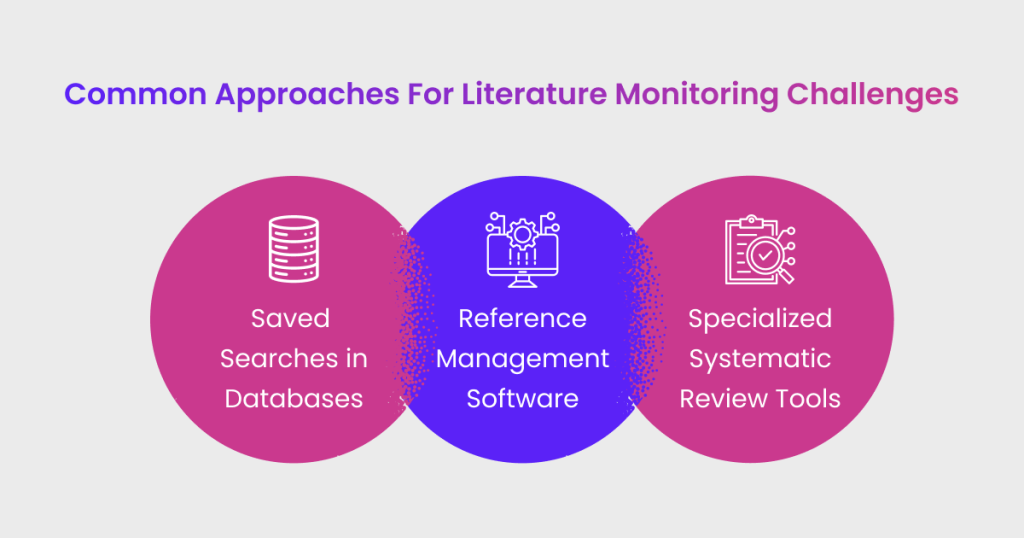
- Saved Searches in Databases
Many teams set up saved searches in databases like PubMed. This reduces the need to manually construct queries each week.
However, this approach works for a single database but do not carry over to other platforms. A PubMed search must be recreated in EMBASE, then again in local language databases or regulatory sources. Each database has different search syntax and export formats and PV teams end up maintaining multiple separate systems to cover all required sources.
- Reference Management Software
Some teams use reference management software such as EndNote or Mendeley. These tools help teams organize and share articles across team members. But these tools were designed for academic research workflows that’s used to collect sources for papers and track references.
PV teams need different capabilities: they need to identify which articles contain valid Individual Case Safety Reports, document regulatory compliance, and transfer validated findings into pharmacovigilance databases. Organizations often build spreadsheet-based workarounds to bridge this gap. As the number of monitored products grows, these manual workarounds become harder to maintain.
- Specialized Systematic Review Tools
Others invest in more specialized systematic review tools that provide structured workflows for screening articles. Although this seems like a good deal in improving the screening process, they still rely on manual duplicate detection and do not solve the multi-database coverage problem. This means that teams must still handle the export and import of data across different systems.
The Common Problem Across All Approaches: Duplicate Detection
Regardless of which approach organizations use, duplicate detection remains a significant challenge. This problem has two forms.
- Same-Article Duplicates
When the same article appears in multiple databases, the formatting often differs. One database might list an author as “Johnson, M.A.” while another shows “Johnson MA.” Journal names appear as “Am J Cardiol” in one place and “American Journal of Cardiology” in another. Manual reviewers might not immediately recognize these variations refer to the same article.
- Same-Case Duplicates
A patient case might first appear as a conference abstract in March. The same case then gets published as a full journal article in June. By September, it might be cited in a systematic review. If different team members review these publications at different times, they might create separate case reports for what is actually a single patient. This inflates the number of reported adverse events and can create misleading safety signals.
“From 2000 to 2010, about 2.5% of reports with adequate information for duplicate analysis in the WHO global pharmacovigilance database were duplicates; the percentage was higher for reports from the literature (11%) and those with fatal outcomes (5%).”
How AI Addresses These Limitations
Artificial intelligence offers a different approach to these challenges and has shown measurable results in pharmacovigilance literature management.
“A 2024 study published in Frontiers in Drug Safety and Regulation found that large language models achieved 97 percent sensitivity in identifying pharmacovigilance-relevant abstracts. Specificity was 67 percent, meaning some irrelevant articles still get flagged for review, but the technology catches nearly all relevant safety information.”
AI systems can understand medical terminology and context across different phrasings. This allows them to recognize adverse drug reaction descriptions even when authors use varied language.
For duplicate detection, AI systems use multiple methods like cross-referencing Digital Object Identifiers, normalizing author names and leveraging advanced GenAI vs traditional automation, techniques to standardizing journal abbreviations. They can also analyze the content of case reports to identify when different publications describe the same patient. Research on these algorithms shows accuracy rates above 95 percent.
For instance, the system identified 52 duplicates that manual review had missed. These missed duplicates had already been processed as separate cases, affecting safety metrics.
“Organizations using AI systems report time reductions of 60 to 70 percent (Applied Clinical Trials, 2025).”
For a drug requiring review of 500 weekly citations with an 11 percent duplicate rate, this represents roughly 50 hours saved per month on duplicate processing. Aprt from this, AI systems maintain consistent performance across high volumes.
“Manual screening accuracy varies with workload and reviewer fatigue, with error rates reaching 15 to 30 percent. A study on AI-assisted data extraction found 99.4 percent accuracy—1,502 correct extractions out of 1,511 data points (Shamim et al., 2024).”
How This Works in Real Pharmacovigilance Workflows
The question now is not whether AI can help with literature monitoring, but how it actually fits into the daily work PV teams do. Let’s walk through what happens when a comprehensive AI-powered system handles literature monitoring from start to finish.
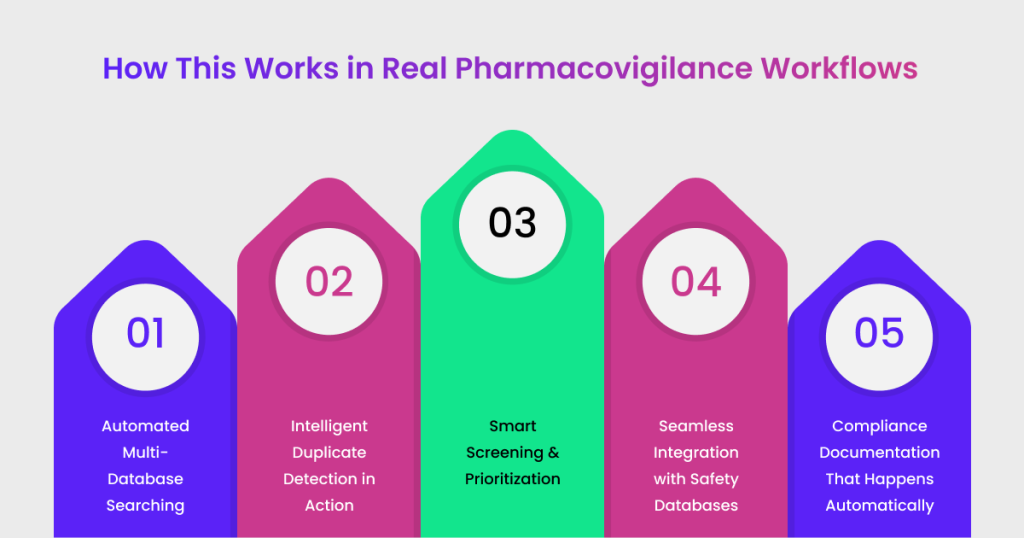
- Automated Multi-Database Searching
Instead of logging into PubMed, then EMBASE, then regulatory databases separately, the system executes queries across all sources simultaneously. It handles the different search syntaxes that each database requires, normalizes the results, and presents everything in a unified view.
This eliminates the need to manually recreate searches across different platforms. For a PV team monitoring 20 products across global markets, this alone saves hours each week that would otherwise be spent on basic search execution.
- Intelligent Duplicate Detection in Action
Here’s where things get interesting. As results come in, the system immediately starts identifying duplicates using multiple methods:
DOI Matching: Cross-references Digital Object Identifiers to catch exact matches Author Normalization: Recognizes that “Johnson, M.A.” and “Johnson MA” are the same person Journal Standardization: Understands “Am J Cardiol” and “American Journal of Cardiology” refer to the same publication Case Narrative Analysis: Reads the content to identify when a March conference abstract and June full article describe the same patient
High-confidence duplicates get automatically merged. Medium-confidence matches get flagged for human review with the relevant details highlighted side by side. This is where PV teams save 60 to 70 percent of their time—time previously spent manually comparing entries across spreadsheets.
- Smart Screening and Prioritization
The AI doesn’t just find articles. It reads them to determine which ones likely contain valid Individual Case Safety Reports. The system tags each article by:
- Specific drug mentions
- Type of adverse event described
- Severity level (fatal, serious, non-serious)
- Regulatory relevance
Articles get organized into priority queues. A case report of a fatal cardiac event with a suspected drug relationship appears at the top. A pharmacokinetic study mentioning the drug in passing appears much lower. PV professionals can focus on high-priority cases rather than spending hours determining which articles warrant detailed review.
- Seamless Integration with Safety Databases
This is the critical part that often gets overlooked. Finding and screening articles faster doesn’t help if you then have to manually type everything into your safety database. The system needs to connect directly with platforms like Argus Safety or ArisGlobal.
When a PV professional validates an article as containing a reportable case, the system transfers all relevant data automatically:
- Article metadata (authors, journal, publication date, DOI)
- Patient demographics and case details
- Adverse event information
- Drug exposure details
- Complete source documentation
This maintains data integrity, eliminates transcription errors, and preserves the chain of custody from literature search through case submission. The integration includes all regulatory metadata that inspectors look for during audits.
- Compliance Documentation That Happens Automatically
Throughout this entire process, the system documents everything without anyone having to manually create records ensuring quality management compliance at every step.
- Which databases were searched and when
- What search terms were used
- How many articles were retrieved from each source
- Which articles were flagged as duplicates and why
- How screening decisions were made
- Who reviewed which articles and when
- What actions were taken on each article
When an inspector asks about your literature monitoring process during an audit, you can provide comprehensive, queryable records rather than trying to reconstruct events from emails and spreadsheets.
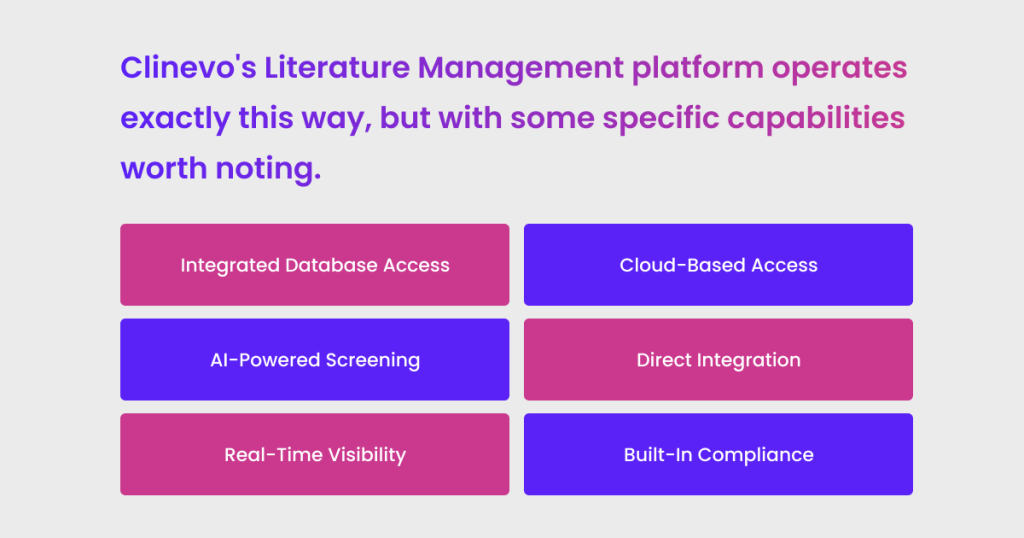
Clinevo's Literature Management platform operates exactly this way, but with some specific capabilities worth noting.
- Integrated Database Access: A single platform provides access to PubMed, EMBASE, regulatory databases, clinical trial registries, and journals, eliminating multiple expensive subscriptions. This means significant cost savings on licensing fees.
- AI-Powered Screening: NLP engine trained on pharmacovigilance terminology reduces false positives by up to 70 percent by understanding drug names, adverse events, and causal language patterns. This means PV teams spend less time reviewing irrelevant articles.
- Real-Time Visibility: Customizable dashboards show article retrieval counts, duplicate detection rates, screening progress, safety signal trends, and compliance metrics as work happens. This means managers can allocate resources effectively and catch issues before they become problems.
- Cloud-Based Access: Browser-based system (IE, Chrome, Firefox) works on any device from anywhere, allowing global teams to collaborate across time zones without software installation. This means uninterrupted literature monitoring regardless of location or time.
- Direct Integration: Connects with Argus Safety, ArisGlobal, and Clinevo Safety to transfer validated articles with complete audit trails into existing workflows. This means no manual data re-entry and zero transcription errors.
- Built-In Compliance: Meets 21 CFR Part 11, ANNEX 11, GxP, and GDPR requirements from the ground up, not as add-ons. This means inspection-ready documentation without additional compliance work.
The distinction between Clinevo and general literature tools or basic automation comes down to design purpose. This system was built specifically for pharmacovigilance workflows, not adapted from academic research tools.
It understands what a valid Individual Case Safety Report looks like. It knows what documentation regulatory inspectors want to see. It integrates with the safety databases PV teams actually use. And it handles the duplicate detection problem that has plagued pharmacovigilance literature monitoring for years.
The result is a system that fits naturally into how PV teams work rather than forcing teams to adapt their workflows to suit the tool.
The Measurable Impact
Organizations implementing Clinevo report specific outcomes:
- Up to 70 percent reduction in time spent on literature screening
- 60 to 95 percent improvement in duplicate detection compared to manual methods
- Significant reduction in false positives requiring review
- Complete audit-ready documentation without manual record-keeping
- Ability to scale literature monitoring without proportionally increasing staff
For a mid-size pharmaceutical company monitoring 15 products globally, benefits of implementing pharmacovigilance software this translates to approximately 200 hours saved per month. That’s time PV professionals can redirect to signal evaluation, causality assessment, and other work requiring medical expertise.
Frequently Asked Questions
Organizations report 60 to 70 percent reduction in literature screening time, which for a mid-size company monitoring 15 products translates to approximately 200 hours saved per month. This means you can scale literature monitoring without proportionally increasing headcount, and redirect experienced PV professionals to higher-value work like signal evaluation and causality assessment.
The system integrates directly with your existing PV databases (Argus Safety, ArisGlobal) without requiring data migration or workflow changes. You can run it parallel with current processes during validation, so there's no disruption to ongoing literature monitoring or compliance activities.
The system maintains complete audit trails showing which AI algorithms flagged which articles as duplicates and why, with all decisions validated by qualified reviewers before final database entry. Inspectors see the same documentation they expect from manual processes, plus automated records that are more complete and consistent than manual documentation.
The AI is designed for high sensitivity (97 percent in studies), meaning it catches nearly all relevant articles, even if it flags some irrelevant ones. All AI decisions go through human validation by qualified PV professionals before case creation, maintaining the same safety oversight as manual processes while improving efficiency.
The system fits into existing PV workflows rather than forcing process changes—validated articles flow directly into the safety databases your team already uses. Teams adopt it quickly because it eliminates frustrating repetitive work (like duplicate checking across databases) while keeping professionals focused on the medical judgment work they were trained to do.
Yes. Most organizations pilot the system with a few products to validate results against their existing processes, then gradually expand coverage. This approach lets you measure time savings and accuracy improvements with real data before committing to full implementation.