





The FDA’s transition is nearly complete. As of April 1, 2026, all premarketing IND safety reports must utilize the E2B(R3) standard. We are now in the final countdown for postmarketing ICSRs; starting October 1, 2026, the FDA will move exclusively to E2B(R3) via Electronic Submissions Gateway NextGen (ESG NextGen), officially retiring the (R2) standard.
The Transition Period Is Closing
The industry has had time to prepare. On January 16, 2024, the FDA began accepting postmarketing Individual Case Safety Reports (ICSRs) in the ICH E2B(R3) format on a voluntary basis. In April 2024, the acceptance expanded to premarketing IND ICSRs
That voluntary window is now gone for IND safety reports, and it is closing fast for postmarketing submissions.
- April 1, 2026: E2B(R3) became mandatory for all IND ICSR submissions to the FDA's Adverse Event Monitoring System (AEMS, formerly FAERS).
- October 1, 2026: E2B(R3) becomes mandatory for all postmarketing ICSRs for drug products, biological products, and drug- or biologic-led combination products submitted via ESG NextGen. After September 30, 2026, the FDA will no longer accept postmarketing ICSRs using E2B(R2) data standards.
In Europe, this transition happened years ago. The EMA’s Management Board confirmed that E2B(R3) reporting to EudraVigilance became mandatory on June 30, 2022, following the launch of the enhanced EudraVigilance system in November 2017.
Critical nuance for sponsors: Once a company begins submitting ICSRs in the E2B(R3) format for a specific product, all subsequent ICSR submissions for that product are expected to use the same standard. There is no switching back to E2B(R2) mid-stream.
What Actually Changed Between E2B(R2) and E2B(R3)
E2B(R3) is not a minor revision. It is a structural overhaul of how adverse event data is captured, encoded, and transmitted. Understanding the specific differences is essential for any pharmacovigilance team preparing its safety database for compliance.
| Dimension | E2B(R2) | E2B(R3) |
|---|---|---|
| Data elements | Approximately 271 data elements | Over 330 data elements, with expanded granularity for patient, product, and reaction data |
| Seriousness assessment | Assessed at case level | Assessed at event level, with multiple seriousness criteria assignable per reaction |
| Technical standard | ICH-developed format | Built on HL7 and ISO standards (ISO 27953-2), enabling interoperability across healthcare systems |
| Missing data handling | Limited options for representing unknown values | NullFlavor support enables valid messages containing mandatory elements even when the content is unavailable |
| Attachments | Provided separately from the ICSR | Embedded directly within the ICSR |
| Product identification | Free-text product fields | Aligned with ISO IDMP standards (ISO 11615, ISO 11616, ISO 11238, ISO 11239, ISO 11240) for structured medicinal product identification |
50
New molecular entities cleared by the FDA in 2024. Each approval extends a post-marketing surveillance obligation that the sponsoring organization must maintain indefinitely — expanding workloads without automatic increases in team capacity.
This shift from case-level to event-level seriousness assessment is particularly consequential for signal management. When a patient experiences multiple adverse reactions, assigning seriousness at the event level provides a more accurate clinical picture, which in turn improves the quality of data feeding into disproportionality analyses and signal detection workflows.
Where Safety Databases Fail the E2B(R3) Test
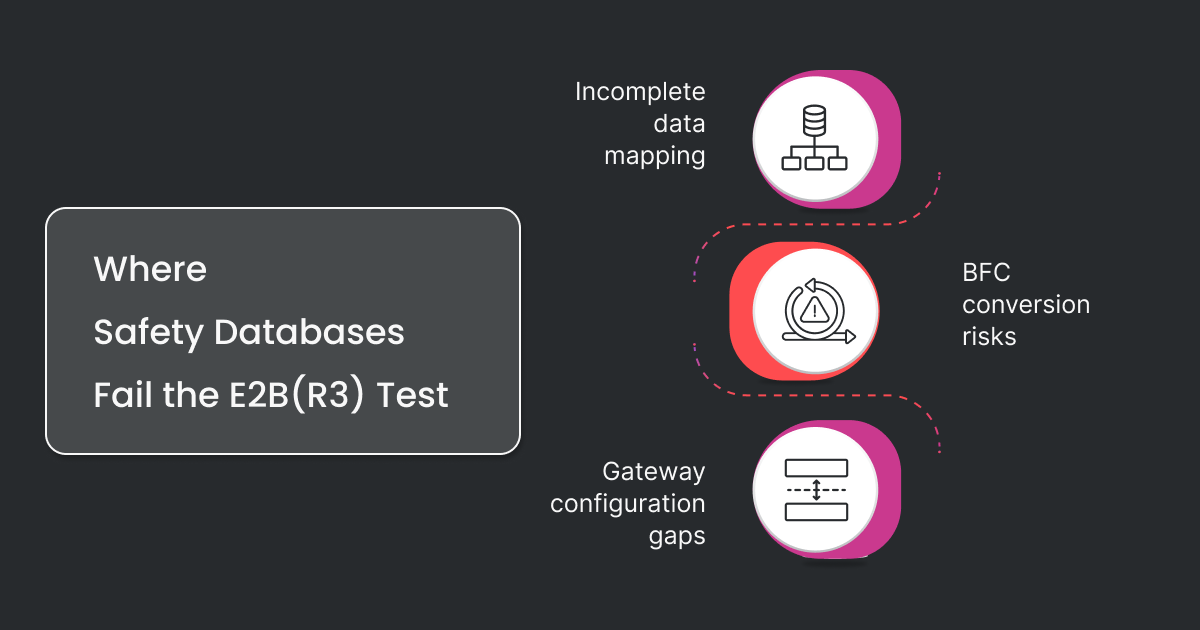
Having a system that can generate XML output is not the same as having one that produces fully compliant E2B(R3) messages. The most common failure points are predictable, and they tend to surface at the worst possible time: during a submission or an inspection.
Incomplete data mapping
The expansion from approximately 271 to over 330 data elements means every field mapping between the safety database and the outbound XML message must be reviewed and validated. Gaps in mapping lead to validation errors, rejected submissions, and rework cycles that strain regulatory timelines. Organizations operating across multiple jurisdictions face an additional layer of complexity because the FDA and EMA apply region-specific implementation requirements on top of the shared ICH standard, particularly around gateway configurations and message header elements.
- Region-Specific Validation Rules: It is a common misconception that an 'ICH-compliant' file will pass everywhere. The FDA’s E2B(R3) Regional Implementation Guide includes specific data constraints - such as Mandatory/Optional (M/O) differences for US-specific fields - that differ from EMA requirements. A database must be able to toggle between these regional variations of (R3) to prevent gateway rejections.
BFC conversion risks
Organizations with historical case data in E2B(R2) format must handle Backward/Forward Compatibility (BFC) conversions. ICH has published conversion rules and mapping spreadsheets to support this process. However, BFC is not a lossless process. Moving seriousness data from case level to event level, resolving ambiguities in product identification fields, and maintaining MedDRA coding consistency during conversion all require careful validation. Automated BFC tools help, but they do not eliminate the need for quality checks on converted data.
Gateway configuration gaps
Even if the ICSR message itself is R3-compliant, the submission infrastructure must also be configured correctly. The EMA uses the EudraVigilance Gateway, while the FDA receives submissions through the ESG NextGen. Message header elements, routing identifiers, and transmission protocols differ between these two systems. A database that works for EudraVigilance does not automatically work for FDA submissions – it requires correct configuration and testing
The transition impacts how data enters the FDA Adverse Event Reporting System (formerly, FAERS). While the FDA has updated its internal processing to the AEMS, the technical gatekeeper remains the ESG NextGen portal.
Unlike the legacy gateway, ESG NextGen offers enhanced transparency and faster processing. However, it requires updated AS2 headers and digital certificates. If your safety database is still configured for legacy ESG protocols, your E2B(R3) messages will fail at the transmission layer regardless of the XML quality.
Submission Pathways Under the New Standard
The FDA offers two pathways for submitting ICSRs in E2B(R3) format:
- Automated database-to-database transmission via ESG NextGen, suited for organizations with high reporting volumes and established IT capabilities. This is the pathway subject to the October 1, 2026, postmarketing mandate.
- Manual entry through the FDA Safety Reporting Portal (SRP) is especially suited for smaller entities with fewer technical resources. However, technical proficiency remains necessary: users must navigate the E2B(R3) data structure and meet all FDA conformance requirements.
It is also worth noting that not all IND safety reports qualify for E2B(R3) XML. Reports covering findings from other studies, animal or in vitro testing results, or increased incidence rate observations still require submission through the eCTD pathway. These reports rely on contextual narrative and study interpretation that the standardized XML structure cannot fully capture.
Operational implication: Sponsors must maintain two distinct submission pathways: E2B(R3) via ESG NextGen for patient-level ICSRs, and eCTD for aggregate or non-clinical safety findings such as DSURs and periodic safety reports. This dual-pathway requirement increases the operational surface area that PV teams need to manage.
IDMP Alignment: The Next Layer of Complexity
E2B(R3) was developed alongside the ISO Identification of Medicinal Products (IDMP) standards. The ICH E2B(R3) Implementation Guide references ISO 11615 (regulated medicinal product information), ISO 11616 (pharmaceutical product information), ISO 11238 (substance identification), ISO 11239 (dose forms and routes), and ISO 11240 (units of measurement).
In 2026, IDMP alignment is no longer a “future-state” luxury. With the (R3) mandate now active, the FDA and EMA are increasingly utilizing structured terminologies for dose forms (ISO 11239) and units of measurement (ISO 11240). Your database must move beyond free-text entry to controlled vocabulary mapping to ensure your ICSRs aren’t flagged for data quality issues during automated FDA signal detection.
This alignment means that structured medicinal product identification data will increasingly replace free-text product fields in ICSR submissions. For literature-sourced adverse events in particular, where product names often appear in non-standardized formats, this adds a data quality challenge at the point of ICSR creation. Safety databases that cannot map incoming product data to IDMP-aligned controlled vocabularies will face growing friction as these standards mature.
While full IDMP implementation timelines vary by jurisdiction, the trajectory is clear: regulators are moving toward a globally harmonized product identification framework, and E2B(R3) is the vehicle through which it enters adverse event reporting.
What an E2B(R3)-Ready Safety Database Should Deliver
This is not a matter of upgrading a single feature. E2B(R3) compliance touches the full ICSR lifecycle, from case intake through processing, validation, and submission. A pharmacovigilance safety database that is genuinely ready for the new standard should deliver the following:
- Pre-submission E2B validation: Internal validation checks against R3 schema requirements, mandatory field completeness, controlled vocabulary alignment, and MedDRA coding consistency, all performed before any submission reaches a regulatory gateway. Catching errors at the gateway creates rework cycles that compress compliance timelines.
- Automated gateway connectivity: Direct, configured connections to both the FDA ESG NextGen and EMA EudraVigilance Gateway, with region-specific message headers, routing identifiers, and acknowledgement handling built into the transmission layer.
- Event-level seriousness support: Data architecture that captures and transmits seriousness criteria at the individual reaction level, not the case level, reflecting the core structural change in R3.
- BFC conversion capability: Tools or validated workflows to convert historical E2B(R2) case data to R3 format, with quality checks for MedDRA coding consistency and data element mapping accuracy.
- IDMP-aligned product fields: Structured product identification fields that can accommodate ISO IDMP vocabularies, positioning the database for the next wave of regulatory harmonization.
- NullFlavor handling: Proper support for transmitting mandatory elements when content is unavailable, preventing message structure errors that cause rejections.
- Audit trail integrity: Every submission, acknowledgement, and resubmission documented in a tamper-evident, time-stamped audit trail that meets 21 CFR Part 11 and EU GMP Annex 11 requirements.
How Clinevo Safety Addresses E2B(R3) Compliance
Clinevo Technologies built its pharmacovigilance safety database with E2B(R3) compliance embedded in the platform architecture, not added as a post-deployment configuration.
The Clinevo Safety platform generates E2B R3-compliant XML output validated against current FDA and EMA submission requirements before any case reaches an external gateway. Built-in E2B validation performs schema checks, mandatory field verification, and controlled vocabulary alignment within the same workflow where the case is processed. This approach eliminates the cycle of submitting, receiving a gateway rejection, and then returning to the case for corrections.
Database-integrated gateway configurations with auto-reporting rules provide a standards-compliant submission layer that connects directly to regulatory gateways. Submission deadlines are tracked automatically, overdue cases trigger compliance alerts, and acknowledgement handling is managed within the platform. For organizations reporting across multiple jurisdictions, this reduces the integration complexity that typically accompanies multi-gateway operations.
The platform’s automated duplicate detection applies intelligent matching algorithms during E2B R2/R3 XML import, identifying potential duplicate cases before they enter the processing pipeline. An E2B difference module supports follow-up (FUP) assessment by distinguishing between significant and non-significant FUPs, helping teams avoid creating duplicate cases from follow-up information that should be linked to an existing record.
Inspection readiness is a core design principle, not a feature. Audit trails are time-stamped and tamper-evident, ICSR case histories are retrievable on demand, and submission records remain within the same environment where cases were processed. Compliance with 21 CFR Part 11, Annex 11, and GxP requirements is system-enforced.
Clinevo Safety also integrates directly with Clinevo’s Literature Management and Signal Detection platforms through secure APIs, ensuring that ICSRs sourced from literature surveillance or flagged through signal evaluation flow into the safety database without manual re-entry or disconnected handoffs.
Frequently Asked Questions
The FDA mandated E2B(R3) for IND ICSR submissions effective April 1, 2026. For postmarketing ICSRs submitted via ESG NextGen, the mandate takes effect October 1, 2026; E2B(R2) submissions will be accepted through September 30, 2026. The EMA has required E2B(R3) for all EudraVigilance reporting since June 30, 2022. While the ICSR data format is shared, the submission infrastructure differs: the EMA uses the EudraVigilance Gateway, and the FDA uses ESG NextGen. Message headers and transmission configurations are region-specific.
ICH has published Backward/Forward Compatibility (BFC) mapping spreadsheets and conversion stylesheets to support transformations between R2 and R3 formats. However, conversion is not lossless. Seriousness data moves from case level to event level, product identification fields may require restructuring, and MedDRA coding must be validated against current term versions after conversion. Automated BFC tools reduce manual effort, but a formal quality review of converted cases is necessary to ensure data integrity in the target system.
AI-driven case intake tools can reliably extract candidate seriousness criteria from narrative text, hospitalisation language, fatal outcomes, life-threatening descriptors, congenital anomalies, and flag them for review with confidence scores. The final seriousness determination remains a regulated medical decision made by a trained reviewer. The role of AI is to surface signals consistently and accelerate triage, not to replace medical judgement.
Literature-sourced ICSRs present a particular challenge under R3 because published case reports often describe medicinal products in non-standardized language. E2B(R3)'s alignment with IDMP standards (ISO 11615, ISO 11238) requires structured product identification rather than free-text entries. This means the literature monitoring platform and the safety database must work together to map extracted product names to controlled vocabularies before ICSR creation.
Validation should cover the full pathway: data capture against R3 field requirements, internal E2B schema validation before gateway transmission, controlled vocabulary alignment (MedDRA, WHO Drug Dictionary, IDMP terminologies), and acknowledgement processing from the receiving authority. Test submissions through the FDA's AEMS validator and the EMA's XCOMP test environment should be part of the validation protocol. Because E2B(R3) is built on HL7/ISO standards, validation documentation should reference both ICH E2B(R3) and the applicable regional implementation guides.