





Ask ten pharmacovigilance (PV) teams to show you the exact Boolean search string used last week to monitor their flagship product, and most will struggle to produce it. They can produce the screening log, the case decisions, even the final ICSRs, but the literal query string, with all its operators, indexed terms, and database-specific syntax, often lives in someone’s PubMed account or a saved Embase session that no auditor can reproduce on demand.
This is the gap that turns an otherwise sound PV program into an inspection finding. The search string is not just a technical artefact. It is the foundation on which every downstream decision rests, and regulators have started treating it that way.
Why the Search String Is a Regulated Artifact, Not a Tool Setting
Under EMA’s Good Pharmacovigilance Practices Module VI, marketing authorisation holders are required to monitor scientific and medical literature systematically, at a minimum on a weekly cadence, using widely indexed databases such as Medline and Embase.The corresponding US obligation under 21 CFR 314.80 requires sponsors to file a 15-day Alert report for any serious, unexpected adverse drug experience identified in the scientific literature, with a copy of the article attached.
Both frameworks share a single underlying assumption: if the published evidence exists, the company is expected to have found it. The search string is the mechanism that makes that responsibility either defensible or indefensible.
GVP Module VI Appendix 2.3.4 is explicit on the point that matters most to inspectors. Regulators do not accept any reduction in recall as a valid trade-off when monitoring published literature for safety information. Precision can be tuned to manage workload, but missing a relevant ICSR sits outside the acceptable boundary.
That single principle reshapes how search strings should be built. The goal is not the cleanest result set. The goal is a defensible recall floor of effectively 100% against the universe of articles that could plausibly contain a reportable adverse reaction. Most teams build for the opposite outcome, often without realising it.
50
New molecular entities cleared by the FDA in 2024. Each approval extends a post-marketing surveillance obligation that the sponsoring organization must maintain indefinitely — expanding workloads without automatic increases in team capacity.
The Five Mistakes That Cause Most PubMed and Embase Search Strings to Fail
Across audit findings, scoping reviews, and industry guidance, the same patterns surface repeatedly. The five mistakes below account for the majority of search strategies that look reasonable on paper but are not built to withstand scrutiny.
Mistake 1: Searching Brand Names, Missing Active Substance Variants
GVP Module VI Appendix 2.3.3 states that PV searches must find records linked to the active substance, not only the brand name. In practice, this means a search string for an oncology product cannot stop at the trade name. It needs the international non-proprietary name (INN), the chemical name, recognised salt forms, prior development codes, and, where relevant, the excipients or adjuvants with pharmacological activity.
Teams that inherit search strings from a predecessor often miss this entirely. The string runs, results return, and the auditor finds a 2019 journal article using the development code that the team never reviewed because the code was not in the query.
Mistake 2: Choosing Between Indexed Terms and Free Text, Instead of Combining Both
Indexed thesauri and free-text searching cover different gaps. Emtree, Embase’s controlled vocabulary, contains more than 100,000 preferred terms and over 550,000 synonyms; MeSH in PubMed contains approximately 30,000 preferred terms.Neither is sufficient on its own.
Indexed terms catch articles that an indexer has tagged with a specific concept, but recently published articles, ahead-of-print records, and conference abstracts often lack full indexing for weeks or months. Free-text title and abstract searching catches those gaps but misses articles where the relevant concept appears only in the full text or where authors use non-standard phrasing.
A defensible PV search string combines indexed terms (MeSH or Emtree), exploded hierarchies for narrower concepts, free-text variants in the title and abstract, and, where supported, subheadings or qualifiers that flag adverse-effects context. Choosing only one of these reduces recall before the search even runs.
Mistake 3: Generic Adverse-Effects Terms Without Product-Specific Coverage
A widely cited methodological study by Golder and Loke evaluated search filters built on generic adverse-effects terms and found that they achieved around 84% sensitivity in MEDLINE and 83% in Embase. Recall improved to over 90% only when product-specific adverse-effect terms were added to the strategy.
For a pharmacovigilance team, that gap matters. A generic-only search will systematically miss roughly one in six relevant articles, which fails the recall standard regulators expect. The fix is layering: build the generic adverse-effects block (terms like adverse drug reaction, drug-induced, toxicity, side effects), then add product-specific known reactions drawn from the Reference Safety Information and the latest signal review.
Mistake 4: Using an LLM to Generate the Search String Without Validation
Asking ChatGPT or another large language model to draft a Boolean search string has become common. The risk is rarely the Boolean logic itself. The risk is that LLMs fabricate terms, MeSH codes, and field tags that look plausible but do not exist.
A 2023 analysis of references generated by ChatGPT for medical articles found that only 7% of citations were authentic and accurate, 46% were authentic but contained inaccuracies, and 47% were entirely fabricated. The failure mode is identical for search-string construction. A hallucinated MeSH heading silently fails in PubMed and returns zero results for that branch of the query, but the overall search still runs and produces outputs, making the failure invisible.
AI-assisted does not mean AI-validated. If a search string was drafted with LLM assistance, every term, qualifier, and field tag must be independently verified against the actual database thesaurus before the string is approved for production. The validation log should record which terms were AI-suggested, which were human-added, and what recall the final string achieved against a gold-standard reference set.
Mistake 5: Documentation That Cannot Be Reproduced Under Inspection
The final mistake is the one that turns the other four from operational problems into compliance findings. Most search-string documentation captures the intent of the search but not the artefact itself.
An inspection-ready record for each weekly search must include the exact search string as executed (with every operator and field tag), the database name and version, the date range covered, the number of records retrieved, the screening decisions per record, and the screener’s identity. Public reporting frameworks such as PRISMA-S, with its 16 reporting items for literature searches,and the PRESS 2015 checklist for peer review of electronic search strategies, set a reasonable baseline for completeness.
The most common gap is not the absence of records, but the inability to demonstrate that this week’s string is the same as last week’s, that any changes were change-controlled, and that the modification rationale is traceable.
Balancing Sensitivity and Precision in PV Literature Search
The instinct to filter out noise is the instinct that breaks compliance. The right sequence is to maximise recall first, then manage precision separately, after the search has run.
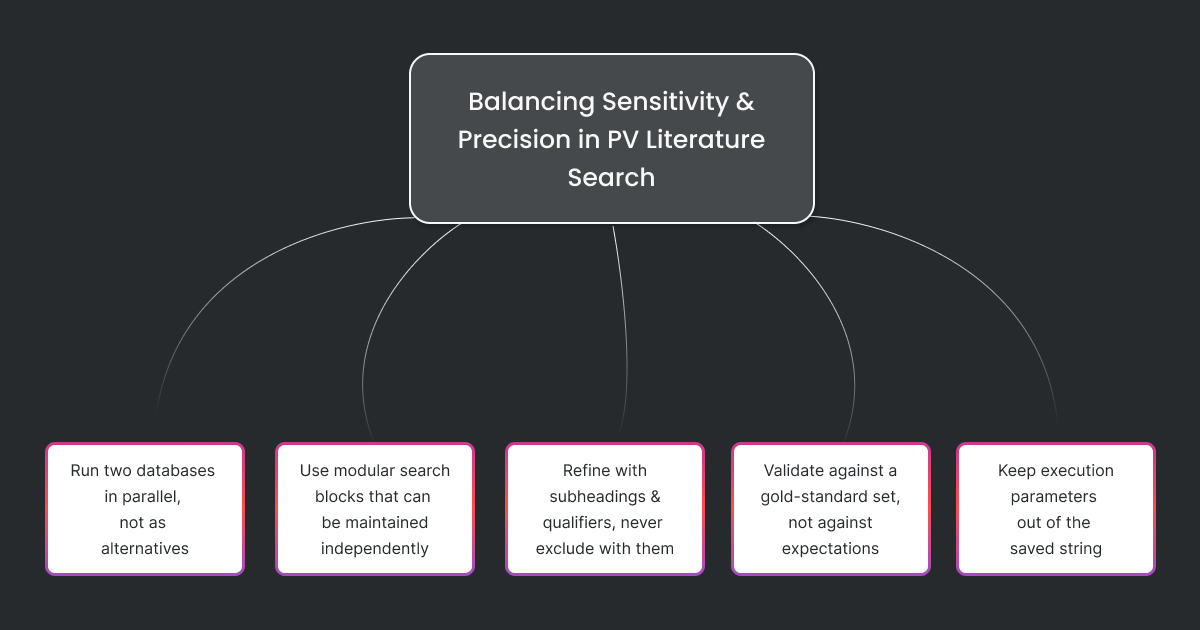
Run two databases in parallel, not as alternatives
GVP Module VI’s expectation that searches cover “widely used reference databases” is deliberate. PubMed/MEDLINE and Embase have substantial but non-identical journal coverage, with Embase indexing thousands of journals and conference proceedings not covered by MEDLINE. A weekly search running against only one source does not meet that expectation, however well-constructed the string is. Maintain functionally equivalent strings on each database, document the syntax differences, and reconcile outputs through deduplication rather than treating either source as authoritative alone.
Use modular search blocks that can be maintained independently
Layering the string into three blocks, a product block (active substance, INN, brand, development codes, salt forms), an adverse-effects block (generic plus product-specific), and, where relevant, a study-design or population block, has benefits beyond clarity. Each block can be peer-reviewed independently, updated when the Reference Safety Information changes without disturbing unrelated terms, and change-controlled with rationale recorded per block. This separates a string that looks compliant on a slide from one that survives a PRESS 2015 peer review of electronic search strategies.
Refine with subheadings and qualifiers, never exclude with them
In MEDLINE, the adverse-effects subheading (ae) and qualifiers like chemically induced (ci), drug effects (de), and toxicity (to) tighten precision while keeping recall intact. In Embase, Emtree’s triple-linking of drug, qualifier, and linked term performs the same role with finer granularity. When applied correctly, these reduce off-topic noise (pharmacokinetic studies, in vitro work, unrelated co-mentions) without lowering the recall floor. Again, if applied as exclusion filters, NOT operators against entire publication types, they routinely remove relevant records and create findings waiting to happen.
Validate against a gold-standard set, not against expectations
Validation here is concrete. Assemble a gold-standard reference set of articles known to be relevant for the product, drawn from past ICSRs, signal evaluations, RMP literature reviews, and previously identified publications. Run the current string against the database and calculate the percentage of the gold set retrieved. Anything below effectively 100% recall indicates the string is systematically missing a class of records. The validation log captures the gold set version, the string version tested, the recall achieved, and the change-controlled response.
Keep execution parameters out of the saved string
Saved strings that hard-code date ranges expire silently the moment the date passes. The same string with date and database scope passed in at runtime remains reusable, comparable across periods, and stable for change control. Small technical effort, large audit-readiness gain.
Noise reduction beyond these techniques is a downstream activity, handled through structured screening triage or automated classification against a curated PV keyword library, never by tightening the search string itself.
How Clinevo's Literature Automation Platform Supports Compliant Search Execution
Effective pharmacovigilance literature automation starts from the premise that the search string is a regulated artefact.
Clinevo’s Literature Automation platform is built on that premise. It does not replace the human strategist designing the search; it removes the documentation and noise-management failures around the strategist’s work.
Three capabilities are directly relevant to the failure modes covered above:
- API-based execution with full audit logging The platform connects directly to PubMed and Embase through their official APIs. Every query, including the exact search string, the timestamp, the database response identifier, and the result count, is captured in machine-readable form. The audit trail required by GVP Module VI is generated as a byproduct of normal operation rather than reconstructed later.
- A 2.5 million-plus curated PV keyword library with automated classification Once retrieval is complete, the platform applies its keyword library and text-classification models to tag each record as ICSR-relevant, PSUR/signal-relevant, or invalid. This handles the precision problem in the right place, after retrieval, so the search string itself can stay recall-first.
- GenAI and NLP extraction trained on PV terminology Relevant records flow through an NLP layer that identifies adverse-event terms, suspect products, seriousness criteria, and reporter context within the article text, with confidence scoring. Validated records can then be exported as ICH E2B(R3)-compliant XML for direct ingestion into the safety database.
The combination matters. A strategist’s recall-first search string, executed through an API-logged platform with classification and extraction applied post-retrieval, produces a compliance record that is reproducible to the exact query and defensible at inspection.
Frequently Asked Questions
The proof comes from validation against a gold-standard reference set, not from the AI tool itself. Maintain a curated list of known relevant articles for each product family (drawn from past ICSRs, signal evaluations, and aggregate reports). Run the AI-drafted string against that set and document the recall achieved. The auditable record should include the original LLM-drafted string, the human-validated final string, the diff between them, and the recall percentage. Anything below an effective 100% recall on the gold set should be revised before the string enters production.
Four recurring patterns: searching brand names only without the active substance and its variants, relying on indexed terms or free text alone instead of combining them, using generic adverse-effects terms without layering in product-specific known reactions, and inadequate documentation that cannot reproduce the exact string executed in a given week. Inspectors increasingly ask for the literal query string, not just the SOP that describes how strings are built.
LLMs can accelerate the drafting of a Boolean string, but they are not yet trustworthy for unsupervised production use in pharmacovigilance. Studies of LLM-generated references have found high rates of fabricated MeSH terms, non-existent field tags, and citations that do not correspond to real articles. For rare adverse events, where every relevant case matters, every term suggested by the model must be verified directly against the database thesaurus, and the final string must be recall-validated against known cases before deployment.
At a minimum: the exact search string executed (with operators, field tags, and syntax preserved), the database queried and its version, the date and time of execution, the date range covered, the number of records retrieved, the deduplication method applied, the screening decision per record with the screener's identity, and any change-controlled modifications to the string with their rationale. The PRISMA-S checklist and the PRESS 2015 guideline are useful starting templates, both of which align well with GVP Module VI Appendix 2 expectations.
Usually, because the tool is doing what it was asked to do, i.e., preserve recall. PV searches are designed to over-retrieve, since regulators do not accept lost recall as a trade-off. The right fix is post-retrieval classification rather than tightening the search string. A platform that tags records as ICSR-relevant, PSUR or signal-relevant, or invalid against a curated PV keyword library can typically reduce manual screening burden by a substantial margin without compromising the recall floor.