

GenAI vs Traditional Automation in Pharmacovigilance: What's the Difference
The pharmaceutical industry is currently facing a data deluge. As adverse event reporting channels expand from traditional forms to social media, patient support programs, and digital health apps, the volume of safety data is exploding. For pharmacovigilance (PV) teams, the manual processing of high-volume, unstructured adverse event data leads to delays, errors, and significant compliance risks.
While automation has been a buzzword in the industry for years, a critical question has emerged in boardrooms and safety departments alike: How is AI transforming pharmacovigilance beyond big data analytics?
The answer lies in the shift from static, rule-based automation to dynamic Generative AI (GenAI). This article explores the nuanced differences between GenAI pharmacovigilance and traditional automation, illustrating why advanced tools like Clinevo Case Intake are essential for modern drug safety monitoring.
The Challenge of Traditional Automation in PV
For the past decade, the industry has relied heavily on Robotic Process Automation (RPA) and standard optical character recognition (OCR). While these tools represent a step forward from purely manual entry, they come with significant limitations.Insert your content here
Traditional automation PV systems operate on strict, predefined rules. They excel at “structured” tasks—moving data from Field A to Field B—, but they fail when faced with ambiguity. In pharmacovigilance, adverse events are rarely reported in a perfect structure. They remain hidden in lengthy emails, call center transcripts, or colloquial social media posts.
When a rule-based system encounters an unstructured narrative that doesn’t fit the set template, it fails, requiring human intervention. This “human-in-the-loop” requirement for every exception creates bottlenecks, ultimately leading to:
- Processing Delays: Backlogs grow as manual review teams struggle to keep up.
- Data Integrity Issues: Fatigue leads to human error in transcription and coding.
- Compliance Risks: Inability to meet strict reporting timelines (e.g., 15-day expedited reporting) due to volume spikes.
Understanding the Limits of Rule-Based Systems
To understand the leap to GenAI, we must first understand the ceiling of current technologies. Traditional RPA is akin to a digital assembly line worker—highly efficient at repeating the same task but incapable of improvisation.
These systems lack semantic understanding. If a patient reports, “I felt a bit woozy after taking the pill,” a rule-based system looking for the term “dizziness” might miss the event entirely unless explicitly programmed with every possible synonym. This lack of adaptability is the primary barrier to seamless pharmacovigilance automation.
GenAI: A Paradigm Shift in Safety Monitoring
Generative AI represents a fundamental departure from static rules. By leveraging Large Language Models (LLMs), GenAI tools possess the ability to understand context, intent, and nuance in human language. These advanced systems are built on transformer architectures that can process natural language, summarize complex documents, and generate coherent narratives—capabilities that make them ideally suited for the data-heavy, regulation-sensitive pharmacovigilance workflows.
Critical Question: Can GenAI reliably handle adverse event detection compared to rule-based systems?
Answer: Yes. Unlike rule-based systems that require exact keyword matches, GenAI interprets context. It can distinguish between a patient saying “I didn’t take the medication because I was afraid of nausea” (no AE) versus “I took the medication and felt nauseous” (valid AE), a distinction that often trips up traditional logic. Recent studies demonstrate that GenAI models like ChatGPT-4 achieved 78% predictive accuracy in extracting signs and symptoms from medical literature and converting them into MedDRA codes, significantly outperforming traditional algorithms. Moreover, when enhanced with Retrieval-Augmented Generation (RAG) frameworks, accuracy in complex PV database queries improved from 8.3% to an impressive 78.3%.
What makes GenAI particularly powerful is its capacity for LLM adverse event processing that mirrors human cognition while operating at machine speed. Rather than following rigid rules, GenAI introduces “dynamic intelligence”—the ability to learn from new data patterns without requiring software engineers to rewrite the code base. This adaptability is the foundation of adaptive AI drug safety. Advanced implementations further leverage RAG (Retrieval-Augmented Generation) pipelines, which extract relevant context from safety databases and regulatory guidance prior to model inference, significantly enhancing output accuracy and relevance.
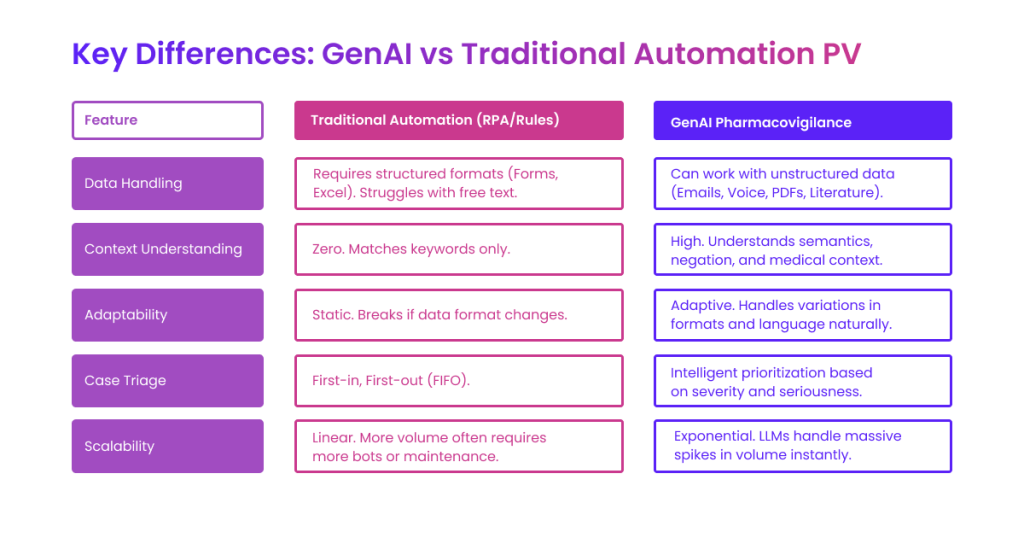
Key Differences: GenAI vs Traditional Automation PV
The following comparison highlights why life sciences companies are migrating toward AI-enabled pharmacovigilance software.
Real Challenges in Adoption
Despite the clear benefits, the industry is naturally cautious. A common question arises: What are the real challenges in adopting agentic AI over traditional RPA in drug safety?
The adoption of GenAI in pharmacovigilance presents unique challenges that demand careful consideration:
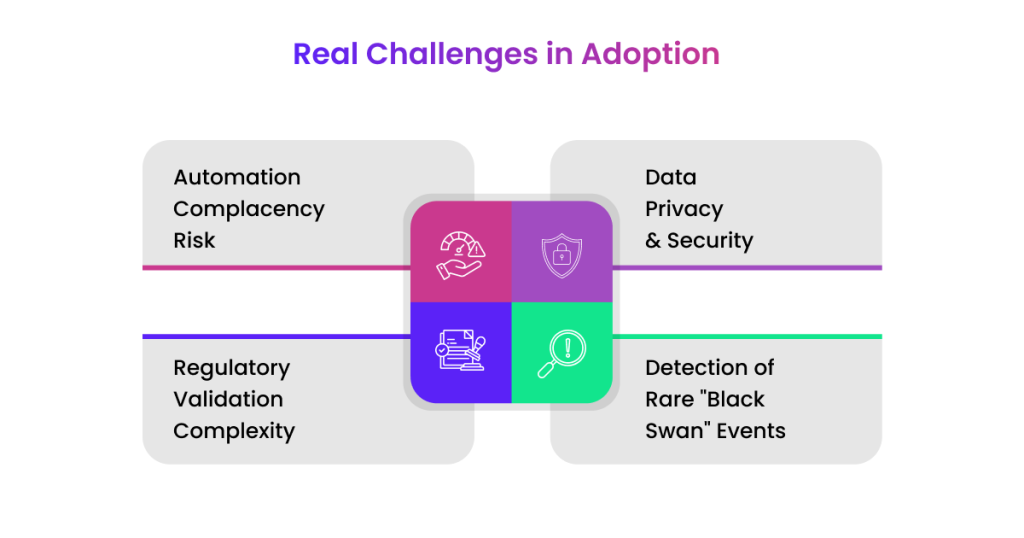
- Automation Complacency Risk: GenAI outputs can appear remarkably polished and confident, creating a dangerous paradox—the better the AI performs, the less vigilant human reviewers become. When AI-generated case narratives seem authoritative, safety reviewers may overlook subtle omissions, accept misleading presentations, or fail to question causality assessments that sound more certain than the underlying data warrants. This “automation complacency” is particularly concerning in pharmacovigilance, where individual case reports already carry emotional weight. Mitigation requires systematic validation protocols with predefined performance criteria, deliberate incorporation of test cases to maintain reviewer vigilance, and “soft guardrails” that surface uncertainty indicators to help reviewers distinguish data-supported conclusions from AI extrapolations.
- Regulatory Validation Complexity: The highly regulated nature of PV demands strict adherence to validation and compliance standards that can complicate seamless GenAI integration. Unlike traditional software with fixed logic, GenAI systems evolve continuously, requiring iterative validation approaches as regulatory frameworks adapt to accommodate AI technologies. Organizations must balance the superior capabilities GenAI offers against the complexity of meeting rigid GxP requirements, necessitating flexible validation strategies that can keep pace with rapidly advancing AI capabilities.
- Data Privacy & Security: PV systems contain personally identifiable information that must be protected under GDPR and HIPAA. GenAI models require careful firewalling to prevent inadvertent learning from protected data, necessitating robust anonymization protocols and controlled access to training datasets.
- Detection of Rare “Black Swan” Events: While GenAI excels at processing common patterns, pharmacovigilance must equally prioritize detecting rare, unexpected safety signals that differ from historical data. AI systems must be specifically tested and monitored for their ability to flag data outliers and emerging signals that don’t fit established patterns—ensuring the technology doesn’t inadvertently suppress novel safety information.
Clinevo addresses these challenges through a multi-layered safety architecture. Our solutions implement “hard guardrails”—automated checks that prevent critical errors like hallucinating key PV terms or patient identifiers—combined with “soft guardrails” that surface uncertainty indicators for human review. Our human-in-the-loop workflows position GenAI as an intelligent assistant that drafts content and flags patterns, while expert reviewers maintain final validation authority.
Clinevo Case Intake: GenAI-Powered Intelligence for Modern Drug Safety
Clinevo Case Intake is purpose-built to address the core challenges facing modern pharmacovigilance operations. Unlike traditional automation tools that struggle with diverse data sources, Clinevo’s solution delivers tangible benefits across the case management lifecycle:
Unified Multi-Channel Intake
One of the most significant advantages is the consolidation of disparate intake streams into a single, unified system. Clinevo Case Intake captures cases from:
- Medical Information Call Centers (MICC) – Phone-based adverse event reporting
- Email channels – Automated ingestion with intelligent case creation workflows
- Web portals – Direct consumer submissions through websites
- Structured and unstructured forms – CIOMS, MedWatch, SAE forms from affiliates and partners
This unified approach eliminates the complexity of managing multiple disconnected systems, ensuring standardized documentation and complete traceability across all sources.
Key Product Capabilities
- Dynamic, Configurable Workflows: Clinevo Case Intake supports flexible workflows tailored to your organization’s specific needs for Product Quality Complaints (PQCs), Medical Inquiries (MIs), and Adverse Events (AEs). This adaptability ensures the system works with your processes, not against them.
- Intuitive Consumer Interface: The platform features a simple, user-friendly interface that allows consumers and reporters to log cases without specialized training—reducing friction in the reporting process and encouraging complete adverse event capture.
- Seamless PV and Quality Integration: Built for interoperability, Clinevo Case Intake integrates directly with existing Pharmacovigilance and Quality Management systems, eliminating data silos and ensuring smooth case handoffs to downstream safety workflows.
- Real-Time Visibility: Actionable dashboards and reports provide real-time monitoring of case metrics, quality indicators, and compliance status—enabling proactive management rather than reactive firefighting.
- Transparent Case Tracking: Consumers and reporters can track updates on their submitted cases directly through the portal, with automated notifications when PV or Quality teams take action—improving stakeholder communication and trust.
Regulatory Compliance Built-In
Clinevo Case Intake is designed with regulatory compliance at its core, ensuring your organization remains audit-ready:
- 21 CFR Part 11 compliant – Electronic records and signatures meet FDA requirements
- Annex 11 compliant – EMA computerized systems validation standards
- GxP adherence – Good practice guidelines for pharmaceutical quality systems
- GDPR compliant – Data privacy and protection for European operations
With robust audit trails, automated compliance checks, and version-controlled documentation, the system provides the foundation for successful regulatory inspections from the FDA, EMA, MHRA, and other global authorities.
Operational Excellence
- Anytime, Anywhere Access: As a cloud-based web application, Clinevo Case Intake is accessible via the internet or intranet on all major browsers (IE, Chrome, Firefox), enabling distributed teams to work efficiently across geographies.
- Cost-Effective Solution: Transparent pricing combined with high-performance infrastructure, comprehensive training, secure hosting, and 24/7 support delivers exceptional value without hidden costs or infrastructure burdens.
- Proven Global Track Record: Trusted by life sciences, pharmaceutical, biotech, and CRO clients across the USA, UK, Europe, Korea, Japan, China, and India—demonstrating scalability across diverse regulatory environments and languages.
The Future of Pharmacovigilance
The landscape of pharmacovigilance is evolving through intelligent augmentation. Adaptive AI drug safety represents a new era where GenAI enhances—rather than eliminates—established practices. These technologies bring dual promise and complexity to high-stakes regulatory environments: the capability to automate data-intensive tasks, analyze unstructured data, and generate insights at scale, combined with the necessity of rigorous human oversight and validation.
By efficiently processing real-world data, social media streams, and emerging datasets alongside traditional structured sources, GenAI widens the lens through which PV systems monitor patient safety. However, this technological capability does not diminish the critical role of human expertise. Rather, it enhances the efficiency of pharmacovigilance professionals in detecting and evaluating safety signals, allowing them to focus their considerable discretion and clinical judgment on complex cases, signal interpretation, and risk-benefit decisions that require nuanced medical understanding.
As organizations navigate this transformation, the question is no longer whether to adopt GenAI in pharmacovigilance, but how to implement it responsibly. Success requires solutions that balance innovation with validation, efficiency with oversight, and automation with human judgment. At Clinevo Technologies, this philosophy shapes every solution we deliver—empowering our clients with intelligent tools that enhance, not replace, their critical expertise.
From our strategic presence across the USA, UK, Europe, and India, we work alongside life sciences organizations facing the real-world complexities of modern drug safety monitoring. The shift from traditional automation to GenAI-enabled pharmacovigilance represents more than a technology upgrade—it’s a fundamental reimagining of how safety teams can work smarter, respond faster, and ultimately protect patients more effectively.

Frequently Asked Questions
The fundamental difference lies in adaptability and context understanding. Traditional RPA operates on strict, predefined rules and requires structured data formats. It excels at repetitive tasks but fails when faced with unstructured narratives or variations in reporting formats. GenAI, powered by Large Language Models (LLMs), understands semantic context, can process unstructured data from emails, social media, and free-text reports, and adapts to format variations without requiring manual reprogramming. This makes GenAI far more suitable for the diverse, high-volume adverse event data.
No. The future of pharmacovigilance is collaborative intelligence, not replacement. GenAI automates data-intensive, repetitive tasks like case intake, data extraction, and initial triage, freeing professionals to focus on higher-value activities that require clinical judgment: complex signal interpretation, causality assessment, risk-benefit analysis, and regulatory decision-making. Organizations using Clinevo Case Intake report that safety physicians spend significantly more time on medical analysis rather than data entry, improving both efficiency and job satisfaction.
Clinevo Case Intake is designed with compliance at its core. The platform is:
- 21 CFR Part 11 compliant for electronic records and signatures
- Annex 11 compliant for EMA computerized systems validation
- GxP adherent for pharmaceutical quality systems
- GDPR compliant for European data privacy requirements
Additionally, the system provides robust audit trails, automated compliance checks, version-controlled documentation, and validation protocols that meet the stringent requirements of global regulatory authorities.
Automation complacency risk refers to the paradox where high-quality AI outputs reduce human vigilance over time. When AI-generated case narratives appear polished and authoritative, safety reviewers may become less critical, potentially missing subtle omissions or failing to question causality assessments. Clinevo addresses this through:
- Systematic validation protocols with predefined performance criteria
- Deliberate test cases to maintain reviewer vigilance
- Soft guardrails that surface uncertainty indicators
- Human-in-the-loop workflows where GenAI drafts content and flags patterns, while expert reviewers maintain final validation authority
This ensures GenAI enhances rather than replaces critical human oversight.
Yes. One of GenAI's key advantages is its ability to process natural language variations across different languages, regional reporting styles, and colloquial expressions. Unlike rule-based systems that require explicit programming for each variation, LLM-powered systems can understand context and intent across languages. Clinevo’s Gen-AI-powered Case Intake has a proven global track record, trusted by clients across the USA, UK, Europe, Korea, Japan, China, and India—demonstrating scalability across diverse regulatory environments and languages.