From Case Intake to Signal Detection: How New-Age Technologies are Reshaping Pharmacovigilance Operations – How Clinevotech is Leading Innovation
The pharmaceutical landscape is currently witnessing an unprecedented explosion in data volume. From clinical trials and electronic health records to social media and scientific literature, the sources of safety data are multiplying exponentially. For Pharmacovigilance (PV) teams, this presents a critical dual challenge: managing vast quantities of data while ensuring stringent regulatory compliance with global bodies such as the FDA, EMA, and MHRA.
The scale of this challenge is staggering. Consider that a single adverse event can be reported through multiple channels—spontaneous reports, literature mentions, social media discussions, and clinical trial databases. Each source requires intake, assessment, coding, and signal evaluation. Traditional manual processes, which were designed for a fraction of today’s data volumes, are buckling under the pressure. Case backlogs grow, signal detection delays increase, and compliance risks mount.
This is where modern technologies, such as AI and advanced automation, become the game-changer. These technologies are fundamentally reshaping the entire pharmacovigilance workflow—from the moment a case is received (intake) to the identification of potential safety signals (detection). For instance, GenAI transforms case intake through intelligent data extraction and automated processing, while sophisticated statistical algorithms and automation revolutionize signal detection. So, labor-intensive processes transform into automated, intelligent safety operations. The result: faster case processing, improved accuracy in signal detection, and scalable compliance—benefits that are no longer optional but essential for competitive advantage and patient safety.
The Limitations of Traditional PV Workflow
Pharmacovigilance has historically been a reactive, labor-intensive discipline. Teams are often bogged down by the sheer volume of Individual Case Safety Reports (ICSRs) and the complexity of signal management.
Key pain points in the traditional workflow include:
- Resource-Intensive Intake: Manual data entry from diverse sources (emails, faxes, literature) is slow, costly, and prone to human error.
- Siloed Systems: Disconnected databases for case processing and signal detection lead to data fragmentation and delayed insights.
- Reactive Signal Detection: Relying on periodic aggregate reporting often means safety signals are detected after risks have already escalated.
- Compliance Risks: As volumes grow, the risk of missing expedited reporting timelines increases, threatening regulatory standing.
The Technology Revolution in Pharmacovigilance
Emerging technologies are revolutionizing how safety teams operate. In case intake, GenAI leverages Natural Language Processing (NLP) and intelligent voice analytics to extract structured data from unstructured sources—transforming raw narratives, phone calls, and PDF documents into actionable safety information. Meanwhile, advanced statistical algorithms and automation in signal detection identify patterns in historical safety data through sophisticated quantitative methods like PRR, ROR, EBGM, and graph-based analytics. This combination allows for the creation of regulatory-compliant PV workflows that are both agile and robust.
Modern technology is fundamentally changing PV operations by:
- Automating Unstructured Data Extraction: GenAI converts raw text from literature, medical notes, and voice calls into structured formats automatically, eliminating the need for manual data entry.
- Enabling Real-Time Monitoring: Advanced automation provides real-time surveillance capabilities through continuous statistical analysis, allowing for early detection of potential adverse effects before safety issues escalate.
- Enhancing Predictive Analytics: Moving from retrospective analysis to prospective risk identification through sophisticated pattern recognition algorithms and temporal trend analysis.
- Improving Regulatory Compliance: Ensuring safety reports are timely, complete, and aligned with global regulatory standards, reducing documentation errors, and improving audit readiness.
- Streamlining Resource Allocation: Reducing manual workload and operational costs, allowing human experts to focus on high-value medical assessments and strategic decision-making rather than data entry.
Core Technologies Powering Modern PV
Two distinct technological approaches are driving the transformation across the pharmacovigilance workflow:
For Case Intake – GenAI Technologies:
- Natural Language Processing (NLP): The ability to extract meaningful information from unstructured text—clinical notes, PDF documents, call transcripts—is critical. NLP algorithms can identify adverse event terms, patient demographics, and causality indicators from diverse narrative sources, significantly reducing manual review time.
- Voice Analytics: AI-powered real-time speech-to-text and comprehension systems enable hands-free case documentation during phone calls, reducing data entry errors and improving call handling efficiency.
- Intelligent Pre-population: GenAI analyzes extracted information and automatically populates case forms with confidence scoring, requiring human validation only for high-confidence entries.
For Signal Detection – Advanced Automation:
- Statistical Algorithms: Multidimensional statistical analysis using PRR, ROR, EB05, EBGM, and Chi-Square methodologies identifies safety signals 2-3 weeks earlier than traditional methods through continuous quantitative monitoring.
- Graph-Based Analytics: Models drugs, events, patients, and risk factors as an interconnected network, enabling faster and more sensitive signal detection through relationship mapping and pattern analysis.
- Propensity Score Adjustment: Automated threshold mapping reduces confounding in signal assessment, making risk estimates more robust, statistically reliable, and suitable for large-scale screening.
- Robotic Process Automation (RPA): Handles repetitive, rule-based tasks across both domains like data entry, duplicate detection, and report generation, significantly reducing manual workload and enhancing data accuracy.
Transforming Case Intake with GenAI
The first mile of pharmacovigilance—case intake—is often the most congested. This is where drug safety case intake automation proves its immense value. Clinevo’s advanced intake solutions, powered by GenAI, automate the ingestion and management of cases from multiple channels—including phone calls, emails, web portals, and structured and unstructured forms—to streamline this critical step.
The first mile of pharmacovigilance—case intake—is often the most congested. This is where drug safety case intake automation proves its immense value. Clinevo’s advanced intake solutions powered by GenAI, automate the ingestion and management of cases from multiple channels—including phone calls, emails, web portals, and structured and unstructured forms—to streamline this critical step.
By implementing Clinevo Case Intake, organizations can achieve up to 50% reduction in processing time.
Clinevo Case Intake’s GenAI-powered automation dramatically reduces the time spent on case receipt, triage, and data entry. By eliminating manual data handling across multiple channels, organizations can accelerate their entire safety lifecycle and reallocate resources to higher-value activities.
Clinevo Case Intake: Key Features
| Feature | Description |
|---|---|
| Unified Web Interface | Single system to log and track Product Quality Complaints (PQCs), Medical Inquiries (MIs), and Adverse Events (AEs) from various channels. |
| Multi-Channel Capture | Seamlessly ingest cases from MICC phone calls, emails, web submissions, and structured/unstructured forms from affiliates and partners. GenAI-powered voice analytics enable automated telephone case intake with real-time speech-to-text and comprehension. |
| Dynamic Workflows | Configurable workflows that support any organization’s needs for PQCs, MIs, and AEs management. |
| Seamless Integration | Direct integration with Pharmacovigilance and Quality systems for efficient downstream case management. |
| Real-Time Monitoring | Actionable dashboards and reports enable real-time tracking of quality, compliance, and case metrics. |
Automation-Powered Signal Detection
Once data is in the system, the focus shifts to surveillance. Traditional signal detection methods can result in “alert fatigue” due to high numbers of false positives. Advanced statistical methodologies and automation in pharmacovigilance are changing this dynamic.
Clinevo Signal Detection enables real-time pharmacovigilance signal analytics through sophisticated statistical algorithms, moving teams from reactive compliance to proactive safety management. This comprehensive, end-to-end solution provides signal identification, assessment, tracking, and management capabilities.
Clinevo Signal Detection: Key Features
| Feature | Description |
|---|---|
| Detect Patterns Earlier | Identify subtle correlations across vast datasets using multidimensional statistical algorithms, including PRR, ROR, EBGM, EB05, and CHISQ. Automated temporal pattern recognition and trend analysis detect safety signals 2-3 weeks earlier than traditional methods. |
| Multi-Source Data Comparison | Ability to perform signal detection on both internal data and external repositories (FAERS, EVDAS, WHO Vigibase), and compare across data sources and time periods using intelligent data fusion technology. |
| Comprehensive Signal Identification | An end-to-end capability for identifying, tracking, assessing, and managing pharmacovigilance signals through one unified interface with graph-based analytics for interconnected network modeling. |
| Smart Signal Management | Detect and manage signals based on DMEs (Designated Medical Events), SUSARs, Events of Interest (EOIs), and custom rules with comprehensive case review capabilities. Propensity score-adjusted algorithms improve signal specificity by 40%. |
| Configurable Thresholds | Set rule-based alerts for qualitative and quantitative signal detection reviews and monitoring, with therapeutic area-based stratification for improved statistical validity. |
| Auto-Triaging & Topic Management | An intelligent rule-based engine automatically triages cases and drug-event pairs, saving significant time and costs while reducing signal investigation time from 2-3 weeks to 2-3 days. |
Integrated PV Workflow: From Intake to Detection
The true power of modern technology in PV is realized when intake and signal detection work seamlessly together. Clinevo Case Intake and Clinevo Signal Detection can be deployed as standalone solutions or integrated as part of the broader Clinevo OnePV platform— providing an end-to-end pharmacovigilance platform that unifies the entire safety workflow.
Seamless Data Flow
When Clinevo Case Intake feeds directly into Clinevo Signal Detection, data flows seamlessly from initial case capture through to signal identification and management. This integration eliminates manual handoffs, reduces errors, and accelerates time to detection. Organizations benefit from a unified PV safety database where intake data immediately becomes available for surveillance analytics.
Flexible Deployment Options
Both solutions are built as cloud pharmacovigilance software offering flexibility and scalability. Whether you’re a biotech managing your first safety database or a large pharma processing millions of cases, the cloud architecture ensures consistent performance, security, and regulatory compliance (21 CFR Part 11, ANNEX 11, GxP, GDPR).
Real-World Impact and ROI
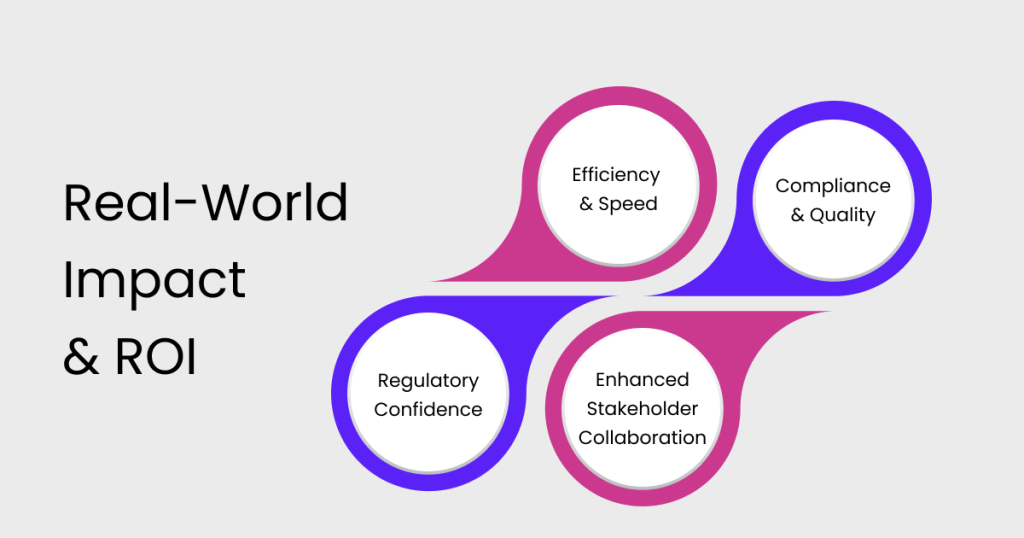
Transitioning to a modern platform with GenAI and automation-based features delivers measurable business value. Organizations adopting these technologies are seeing transformative results in both compliance and operational efficiency.
Efficiency and Speed
How are teams using integrated solutions like Clinevo Case Intake and Signal Detection to automate the full PV workflow? The answer lies in the seamless handover of data. Clinevo Case Intake eliminates manual data entry bottlenecks with its GenAI-powered multi-channel automation, delivering 50% reduction in processing time and operational efficiency. Meanwhile, Clinevo Signal Detection accelerates surveillance through automated rule-based triaging and quantitative statistical algorithms, reducing signal investigation time from weeks to days and allowing teams to handle volume spikes without proportional headcount increases.
Compliance and Quality
With modern technologies reshaping pharmacovigilance, the real impact of end-to-end systems on compliance is profound. Integrated systems ensure a continuous audit trail. Unlike legacy tools, where data transfers can obscure lineage, a unified platform maintains rigorous data integrity, essential for inspections by the FDA or EMA.
Regulatory Confidence
For those questioning how cloud PV databases handle regulatory submissions compared to legacy tools: Modern cloud platforms like Clinevo are pre-validated and constantly updated to reflect the latest regulations (e.g., E2B R3 standards). This ensures that regulatory submissions and audit trails are not just compliant, but “inspection-ready” at all times.
Enhanced Stakeholder Collaboration
Technology-driven platforms improve collaboration across the entire pharmacovigilance ecosystem. Pharmaceutical companies and regulators benefit from transparent, real-time data analysis. Healthcare providers gain actionable insights for patient care decisions. Patients experience safer therapies through faster adverse event detection and response. This interconnected approach transforms safety monitoring from an isolated function to a collaborative effort.
Addressing Implementation Challenges
While the benefits of modern technology in pharmacovigilance are substantial, successful implementation requires addressing several key challenges spontaneous reports and electronic health records:
While the benefits of modern technology in pharmacovigilance are substantial, successful implementation requires addressing several key challenges spontaneous reports and electronic health records:
Data Complexity and Volume
Pharmacovigilance systems rely on a broad spectrum of data—from spontaneous reports and electronic health records to social media, clinical trials, and scientific literature. Managing and integrating these unstructured, diverse data sources demands advanced data governance and quality assurance frameworks. Modern systems must be designed to handle this complexity, ensuring they can sift through vast volumes of data while maintaining accuracy and relevance.
Rare Adverse Event Detection
Detecting rare or uncommon adverse drug reactions (ADRs) remains a challenge due to the scarcity of relevant data. Advanced statistical methodologies combined with access to large datasets significantly enhance detection capabilities. A hybrid approach—merging sophisticated pattern recognition algorithms with expert medical insight—proves most effective in identifying these outliers. Graph-based analytics enable discovery of rare adverse events in small patient populations by modeling interconnected relationships.
Ensuring Data Quality and Reducing Bias
Systems are only as good as the data they process. For GenAI-powered case intake, training datasets must be representative of diverse demographics and geographic populations to avoid bias in data extraction and NLP processing. For signal detection, propensity score-adjusted algorithms and therapeutic area-based stratification help reduce confounding and improve statistical validity. Ongoing monitoring and diverse, well-rounded datasets are critical to ensure systems remain accurate and unbiased across all populations.
Real-Time Signal Prioritization
In pharmacovigilance, timely signal detection is paramount. Balancing the need for speed and accuracy—while avoiding both false positives and missed signals—requires sophisticated statistical models and continuous fine-tuning. Advanced automation must be equipped with intelligent rule-based engines and configurable thresholds to prioritize the most pressing safety signals in real-time, allowing for rapid decision-making without compromising safety outcomes. Automated signal assessment workflows reduce investigation time from weeks to days while maintaining scientific rigor.
The Broader Industry Context
Clinevo’s solutions are part of a global movement toward technology-powered drug safety. Regulatory databases like VigiBase (WHO’s global adverse reaction database) and EudraVigilance (EU’s safety reporting system) are incorporating advanced algorithms for pattern detection. Research initiatives demonstrate the predictive potential of sophisticated analytics in identifying emerging risks.
In this evolving landscape, Clinevo Case Intake and Clinevo Signal Detection address potential implementation challenges through comprehensive validation protocols, diverse training datasets for GenAI components in case intake, transparent algorithm documentation for statistical methodologies in signal detection, and adherence to global regulatory standards. These tools align with international best practices, providing commercial-grade solutions that make enterprise-level safety surveillance accessible to organizations of all sizes—from emerging biotechs to global pharmaceutical leaders.
Conclusion: Leading the Charge in the Future of Pharmacovigilance
The future of pharmacovigilance combines the intelligence of GenAI with the precision of advanced automation. As the industry moves toward predictive safety, GenAI-powered case intake is revolutionizing how data is captured and structured, while sophisticated statistical algorithms are not only detecting adverse events but anticipating patterns with unprecedented accuracy.
At Clinevo Technologies, we are committed to being at the forefront of this revolution. With Clinevo Case Intake leveraging GenAI for intelligent data extraction and Clinevo Signal Detection utilizing advanced statistical automation for pattern recognition, we empower our partners with the most advanced, compliant, and efficient solutions to streamline and enhance their pharmacovigilance operations. These tools help shift pharmacovigilance from a cost center to a strategic asset—driving efficiency, accuracy, and compliance across all stages.
By leveraging Clinevo’s solutions, organizations can achieve faster case processing, improved signal accuracy, and scalable compliance—ultimately enhancing patient safety and regulatory assurance.