




Pharmacovigilance teams aren’t being asked whether they use AI anymore — they’re being asked to prove they can control it. That shift is what defines 2026.
Regulators have moved beyond curiosity about machine learning in drug safety. They expect pharmaceutical organizations to demonstrate how AI systems are governed, validated, monitored, and audited across the safety lifecycle. The joint release of guiding principles by the FDA and EMA in early 2026 made one thing explicit: AI governance in pharmacovigilance must be explainable, traceable, and inspection-ready — no different from any other GxP-regulated system.
For safety teams already using AI for safety signal detection and triage, or adverse event case processing automation with AI, the focus has changed. It’s no longer about efficiency gains alone; now, the aim is to ensure every model decision, automation rule, and LLM-generated narrative can withstand regulatory scrutiny.
Consequently, across safety forums, industry working groups, and internal governance boards, one operational question keeps surfacing
How do you document, validate, and defend AI-driven decisions in pharmacovigilance workflows during an FDA or EMA inspection?
Addressing this question requires that organizations design compliant AI workflows intentionally, instead of retrofitting governance after deployment. In this blog, we deep dive into the different aspects of AI governance in pharmacovigilance.
Regulatory Imperatives: Why AI Inspection Readiness is a Baseline Requirement
While it is true that AI can strengthen pharmacovigilance and reduce time-to-market, regulatory agencies emphasize that companies maintain industry standards for quality, safety, and efficacy. This raises a critical caveat: pharmaceutical companies bear complete responsibility for any AI-generated content or decisions, regardless of the tool used. To build compliant AI workflows in PV, human executives must address three fundamental questions:
- Can you reconstruct every AI decision with complete traceability? Inspectors will want to see the data that went in, the model version that processed it, and the human oversight that validated the output.
- Can you prove your AI system performs within defined parameters? Regulators expect documented performance metrics, drift monitoring, and clear criteria for when human intervention is required.
- Can you demonstrate continuous compliance throughout the AI lifecycle? From initial validation through ongoing monitoring to eventual retirement, every phase must follow GxP and good machine learning practice in PV principles.
Best Practices for AI Governance in Drug Safety and PV
Establish Clear Accountability with a RACI Framework
The first step in building defensible AI workflows is defining who owns what. Following best practices for AI governance in drug safety and pharmacovigilance, primary accountability must sit with the PV process owner — not within IT or data science functions.
However, inspection-ready governance cannot operate under a single stakeholder. It requires a federated operating model where accountability, risk oversight, data stewardship, and technical execution are clearly separated but collaboratively governed.A robust governance structure includes:
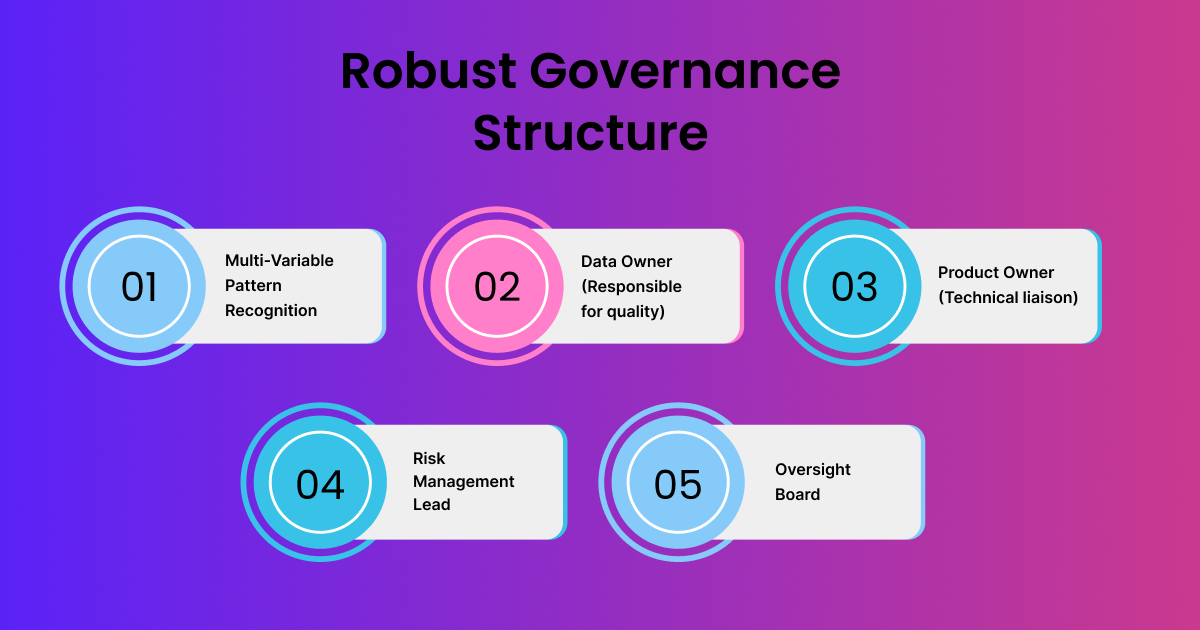
- Process Owner (Accountable): The PV team member responsible for the business process using the AI, focused on outcomes rather than technical implementation
- Data Owner (Responsible for quality): Accountable for classification, protection, use, and quality of input data
- Product Owner (Technical liaison): Bridges the gap between technical AI implementation and business requirements
- Risk Management Lead: Coordinates risk identification, assessment, and mitigation strategies
- Oversight Board: Provides governance across technical, business, and risk domains
This structure ensures that when an inspector asks, “Who is responsible for this AI decision?” there’s a clear answer with documented authority and expertise.
Control Plans as Documentation Strategy
A control plan acts as the AI system’s living defense strategy. It documents how safety teams monitor, measure, and manage AI implementations throughout their operational life—a critical element of audit-ready pharmacovigilance processes.
Essential Components of an Audit-Ready Control Plan
1. Performance Parameters and Monitoring Thresholds
Document exactly what “acceptable performance” means for AI systems. This includes:
- Accuracy metrics benchmarked against human performance or validated standards
- Confidence thresholds that trigger human review
- Data drift detection parameters
- Latency and availability requirements
2. Risk Mitigation Strategies
All risks must have mitigation plans that include actions, timeframes, allocated responsible persons, and effectiveness checks, managed within defined timeframes and reviewed routinely. When inspectors arrive, they’ll want to see not just what could go wrong, but the measures used to prevent it.
3. Human-in-the-Loop Protocols
One of the most common questions safety teams face is: “What’s the best way to keep a ‘human in the loop’ for AI signal detection in PV without losing the efficiency gains?” The answer lies in risk-based monitoring with documented ramp-down criteria. The control plan should specify:
- Initial human review rates (often 100% during validation)
- Performance criteria that must be met before reducing oversight
- Ongoing random sampling rates based on risk assessment
- Triggers that automatically escalate cases back to full human review
The key insight for human-in-the-loop pharmacovigilance: AI doesn’t need to perform “better than or equal to” a human—it needs to perform within the documented, validated parameters in the control plan. This distinction offers the flexibility to reduce human monitoring as confidence grows, provided teams can demonstrate the AI remains within established guardrails.
Implementing Robust Audit Trails and Traceability
The ten principles emphasize a human-centric, risk-based approach with proportional validation, a clear definition of context of use, adherence to applicable standards, and robust data governance, with lifecycle performance monitoring. At the heart of this governance sits the audit trail—the technical proof that everything is traceable and compliant.
What Regulators Expect in AI Audit Trails
Traditional GxP audit trails capture who did what, when, and why. AI audit trails must go further, documenting:
Model Provenance and Versioning
- Which model version processed each case
- Training data lineage and quality metrics
- Model performance benchmarks at deployment
- All updates or retraining events with change control documentation
Decision-Level Traceability
Each report assessed by the AI model should generate an audit entry showing which model version evaluated it, the decision made, the algorithm’s confidence score, and the safety analyst’s final determination linked to the AI assessment. This creates an unbroken chain from input to output to human verification.
ALCOA++ Compliance in the AI Context
The AI audit trail must satisfy the same data integrity principles as any GxP system:
- Every AI decision linked to specific model version and user
- Logs readable and interpretable by auditors
- Timestamps on all AI operations
- Primary records of AI inputs and outputs preserved
- AI outputs verified against source data
- All AI processing steps captured, no gaps
- Audit trail format standardized across systems
- Records maintained for regulatory retention periods
- Audit trails accessible for inspection on demand
Under 21 CFR Part 11 and EU GMP Annex 11, audit trails must use secure, computer-generated, time-stamped records to independently document the date and time of operator entries and actions that create, modify, or delete electronic records. For AI systems, this means capturing not just final outputs but the entire computational pathway.
Addressing the LLM Challenge: How to Handle Hallucinations in AI-Generated Narratives
Large language models have emerged as powerful LLM use cases in adverse event case processing and narratives, with applications ranging from multilingual report translation to narrative drafting. But their tendency to generate plausible-sounding but incorrect information—hallucinations—presents a unique challenge in a safety-critical domain where every word matters.
The Scale of the Hallucination Risk
LLMs can erroneously suggest that an adverse event report details a serious event (for example, liver failure) when this is not mentioned in the source report, potentially signaling a false-positive safety concern and diverting resources from legitimate safety investigations. In pharmacovigilance, even a single fabricated detail can trigger unnecessary regulatory actions or mask real safety signals.
Research testing multiple leading LLMs with clinically designed vignettes containing fabricated details found that models repeated or elaborated on planted errors in up to 83% of cases, with mitigation prompts halving the rate but not eliminating the risk. This data makes clear that deploying LLMs without guardrails in PV workflows is unacceptable from both a patient safety and regulatory compliance perspective.
Implementing Guardrails for LLM Use in PV
To make LLM use cases in adverse event case processing and narratives truly audit-ready, implement these technical controls:
Semantic Matching and Verification
Guardrails should include mechanisms to detect anomalous documents, identify incorrect drug names or adverse events, and match terms between source reports and LLM outputs to prevent hallucinations. For example, if the LLM is translating a Japanese ICSR to English, implement automated checks that:
- Verify all drug names in the output appear in the source
- Confirm adverse event terms are accurately transferred
- Flag any medical concepts in the output not present in the input
- Validate MedDRA coding consistency
Retrieval-Augmented Generation (RAG)
Rather than relying solely on the LLM’s training data, ground responses in verified source documents. RAG systems can decrease hallucination rates by 60-80% by anchoring responses to verified documents. For adverse event narrative generation, this means:
- The LLM can only reference information from the source case report
- External medical information must come from validated knowledge bases
- All factual claims must trace back to specific source fields
Multi-Stage Review and Fact-Checking
Implement a layered verification approach that creates audit-ready pharmacovigilance workflows with machine learning:
- LLM generation: Create initial narrative draft
- Automated fact-checking: Compare output to source data for consistency
- Confidence scoring: Flag low-confidence sections for review
- Human verification: Safety professionals review flagged content
- Audit trail capture: Document all stages with version control
Built-in audit trails and version control ensure each version of the narrative is automatically tracked and stored for easy accessibility and comparison. This makes it possible to demonstrate during an inspection exactly how the LLM output was verified before entering the safety database.
Validation: Demonstrating AI System Performance and Regulatory Compliance
Validation isn’t just a checkbox exercise—it’s the foundation of defense when regulators question AI systems. Following GxP and good machine learning practice in PV, AI must be assessed to identify potential risks, which are documented, monitored, and included in quality management documents, inspection readiness documents, and a control plan.
The AI Validation Lifecycle
Pre-Deployment Validation
- Define intended use and context clearly (signal detection, case triage, etc.)
- Establish acceptance criteria based on performance metrics
- Test on representative datasets that mirror production data
- Document bias testing across demographic subgroups
- Validate against a human expert benchmark or gold standard
- Secure Quality Assurance approval before go-live
Continuous Performance Monitoring
Detecting deviations caused by varying input data, such as detecting outliers and data drift, is critical, with monitoring of the AI’s input and output data analogous to quality check procedures verifying that human workers perform tasks within defined parameters. Implement real-time dashboards tracking:
- Model prediction accuracy over time
- Data distribution shifts from the training baseline
- Error rates by case type or product
- System latency and availability
- False positive/negative rates for critical decisions
Change Control and Revalidation
Every AI update requires documented change control:
- What changed (model architecture, training data, parameters)
- Why the change was needed (performance degradation, new requirements)
- Impact assessment on validated workflows
- Revalidation testing results
- QA approval of changes
The Inspection Perspective: What Regulators Look For
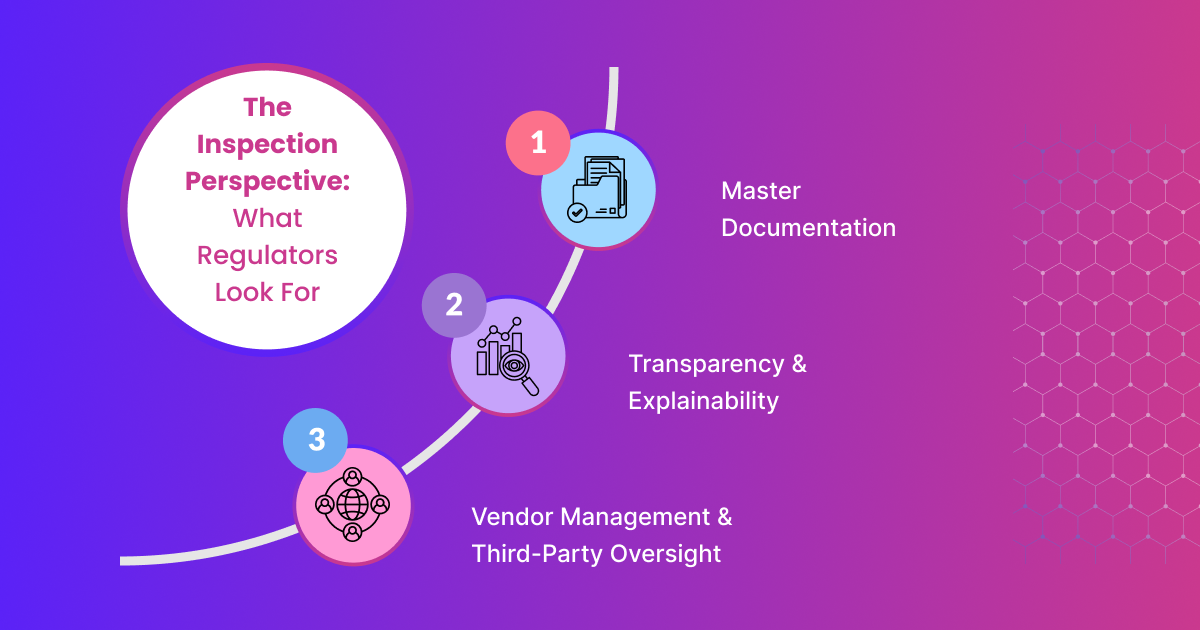
When FDA or EMA inspectors examine AI-enabled pharmacovigilance systems, they evaluate if the company has adequate controls to ensure patient safety. Based on current regulatory expectations for AI in drug safety, prepare to demonstrate:
1. Master Documentation
Safety departments must keep a central listing of all AI implementations in use for audit purposes, potentially within the Pharmacovigilance System Master File or similar managed document. This master list should include:
- Each AI system's purpose and scope
- Risk classification and validation status
- Model versions in production
- Performance metrics and monitoring plans
- Responsible parties and oversight structure
2. Transparency and Explainability
The pharmacovigilance process owner must possess a comprehensive understanding of the AI at a process level, can effectively communicate its operation as related to patient safety and risks, and should consider how to explain the AI to non-experts to give assurance to regulators. Be prepared to explain in plain language:
- How the AI makes decisions (without necessarily exposing proprietary algorithms)
- What data it uses and how data quality is assured
- Where humans remain in the loop and why
- How to know when the AI is working correctly
- What happens when the AI fails or produces unexpected results
3. Vendor Management and Third-Party Oversight
If using commercial AI solutions, inspectors will examine vendor management strategies. Contracts must support the pharmaceutical company’s procedures governing AI adoption, with consideration for allowing visibility or access to regulators of data or information not routinely available, including AI algorithms and test datasets. Vendor agreements should address:
- Access to algorithm documentation for inspection purposes
- Support during regulatory audits or inspections
- Change notification procedures for model updates
- Performance data sharing and reporting
- Compliance with GxP and data privacy requirements
The Path Forward: Moving from Compliance to Confidence
The convergence of advanced AI capabilities and heightened regulatory expectations has created a critical inflection point for pharmacovigilance. Organizations that proactively build comprehensive governance frameworks will not only meet compliance requirements but also unlock the transformative potential of AI to strengthen safety monitoring and protect patients more effectively.
Practical Steps to Achieve Inspection Readiness
Conduct an AI Governance Assessment
Inventory all AI systems currently in use or planned for PV workflows. For each system, evaluate:
- Current governance maturity (roles, documentation, oversight)
- Audit trail completeness and ALCOA++ compliance
- Validation status and ongoing monitoring
- Risk management and control plan adequacy
- Vendor management and contract alignment
Develop a Control Plan Template
Create a standardized template that captures all essential elements: performance parameters, risk mitigations, monitoring protocols, human oversight plans, and escalation procedures. This template should be approved by the QA team and become part of the standard AI deployment process—a cornerstone of best practices for AI governance in drug safety and PV.</spa
Establish Routine Oversight Mechanisms
Pharmacovigilance teams must have oversight mechanisms in place prior to AI going live in production, with audits recommended before go-live to ensure validation documentation, control plans, and risk management activities are appropriate. Implement quarterly AI governance reviews examining:
- Performance metric trends across all AI systems
- Risk register updates and mitigation effectiveness
- Audit trail integrity and completeness
- Change control compliance
- Training and competency of AI system users
Conclusion: Governance as a Competitive Advantage
Companies that understand how to build compliant AI workflows in PV are focusing on the right question – How are pharma safety teams documenting AI decisions in pharmacovigilance so they can defend them in FDA/EMA inspections?”
The key is to develop and implement governance frameworks that treat AI not as a black box that must be explained retroactively, but as a validated, monitored, risk-managed component of the pharmacovigilance system—one that’s inspection-ready from the get-go.
At Clinevo Technologies, our solutions are designed to address these AI challenges head-on. Our PV platforms are engineered with AI governance, auditability, and regulatory compliance embedded at the architectural level. From built-in audit trails that automatically capture every AI decision pathway to validation frameworks aligned with GxP and good machine learning practices, we help pharma companies deploy AI with confidence.
Frequently Asked Questions
At minimum, your documentation must include: a system description in your Pharmacovigilance System Master File (PSMF), validation records showing the AI performs within defined parameters, a control plan documenting performance metrics and monitoring protocols, risk assessments with mitigation strategies, complete audit trails meeting ALCOA++ standards, and vendor agreements (for third-party AI) that address regulatory access and support during inspections.
Traditional software validation focuses on deterministic outputs—the same input always produces the same output. AI/ML validation must also address: model training data quality and representativeness, bias testing across demographic subgroups, performance degradation over time (data drift), the ability to explain decisions to non-technical inspectors, and continuous monitoring since AI behavior can change as input data evolves. Change control is also more complex because even minor retraining can alter outputs significantly.
Conduct a retrospective governance assessment of legacy AI systems. Document the current state, identify gaps against current standards (RACI ownership, control plans, audit trails, validation status), and develop a remediation plan with timelines. Prioritize systems by risk—those used for critical safety decisions or regulatory submissions should be addressed first. Consider whether re-validation is needed or if enhanced monitoring and documentation can bring the system into compliance.
The most effective approach combines multiple layers: implement retrieval-augmented generation (RAG) to ground outputs in source documents, use semantic matching to verify all drug names and adverse events in the output appear in the source input, add confidence scoring that flags low-confidence sections for mandatory human review, establish strict prompting that prohibits the LLM from adding information not present in the source, and maintain version-controlled audit trails showing all edits between LLM draft and final narrative. Never deploy LLMs without human verification as the final step.
Control plans should be living documents reviewed quarterly at a minimum, with immediate updates triggered by: significant performance degradation, model updates or retraining, changes to the underlying process or data sources, identification of new risks, regulatory guidance updates, or findings from audits/inspections. Annual comprehensive reviews should assess whether the AI is still fit for purpose and whether the risk profile has changed.