





Every week, a pharmacovigilance team opens their literature monitoring queue to find hundreds of articles pulled from PubMed, EMBASE, and regional databases. The majority of these articles are often duplicates, off-label mentions, or pharmacokinetic studies that lack any meaningful adverse event content, adding unnecessary noise to the process. This is precisely the problem that AI literature management is designed to solve — not by adding another layer of retrieval, but by bringing intelligence into every stage of the workflow.
The EMA’s own 2024 Annual Report on EudraVigilance puts this problem in clear numbers. In 2024, the agency reviewed 1,254 potential safety signals. Of those, 76% were not validated and closed. Only 3.1%, were ultimately prioritised and assessed by PRAC. That ratio reflects a broader industry challenge: when literature monitoring generates excessive noise upstream, safety teams spend more time triaging irrelevant content than evaluating genuine signals. The downstream effect shows up in validation rates.
Pharmacovigilance (PV) teams need more than just additional layers of automation. They need AI-driven literature management with end-to-end pharmacovigilance workflows, connecting the full pipeline from search through AI triage, Individual Case Safety Report (ICSR) detection, duplicate resolution, and transfer into safety systems, with human oversight built in at the right points.
This article explains how that pipeline works, where it typically breaks down, and what building an audit-ready AI literature management process actually involves.
The Scale of the Problem
As of March 2025, PubMed contains more than 39 million citations.
EMBASE holds 49 million records and adds an average of 8,535 new entries every working day.
A company monitoring 15 to 20 products globally runs hundreds of weekly searches across indexed databases, regulatory websites, and conference repositories, and that is before accounting for ahead-of-print articles and grey literature.
The regulatory mandate is not optional.
- EMA's Good Pharmacovigilance Practices Module VI requires systematic literature surveillance at a minimum weekly frequency, with full documentation of search strategies and screening decisions.
- The FDA's guidance sets the same expectation.
For instance, failure to identify and document an Individual Case Safety Report (ICSR) that’s buried in a journal abstract, could lead to serious regulatory consequences.
However, the sheer scale of literature to be reviewed introduces significant manual effort. Pharmacovigilance teams must sift through a vast volume of irrelevant, redundant, and off-target content, making it nearly impossible to keep up with the fast-paced regulatory landscape. This manual workload exacerbates the issue, leading to inefficiencies and missed opportunities for timely detection of safety signals.
AI literature management changes the equation.
NLP for case processing has reached a 62% implementation rate across pharmaceutical companies, making it the most mature AI application currently in use across PV operations – a sign that the industry has moved past experimentation and toward operational deployment. Yet implementation of retrieval-stage automation alone has not resolved the core problem: what happens after the article arrives is where AI-driven literature management delivers its real value.
Where Automation Breaks Down
Most PV teams have some level of automation in place. The issue is that it tends to stop at the retrieval stage. Articles come in automatically, but everything that follows, including triage, duplicate checking, ICSR validation, and data entry, remains manual.
Without AI literature management connecting these stages, teams are left with a pipeline that is merely patched with an automation layer at the front, creating three consistent failure points:
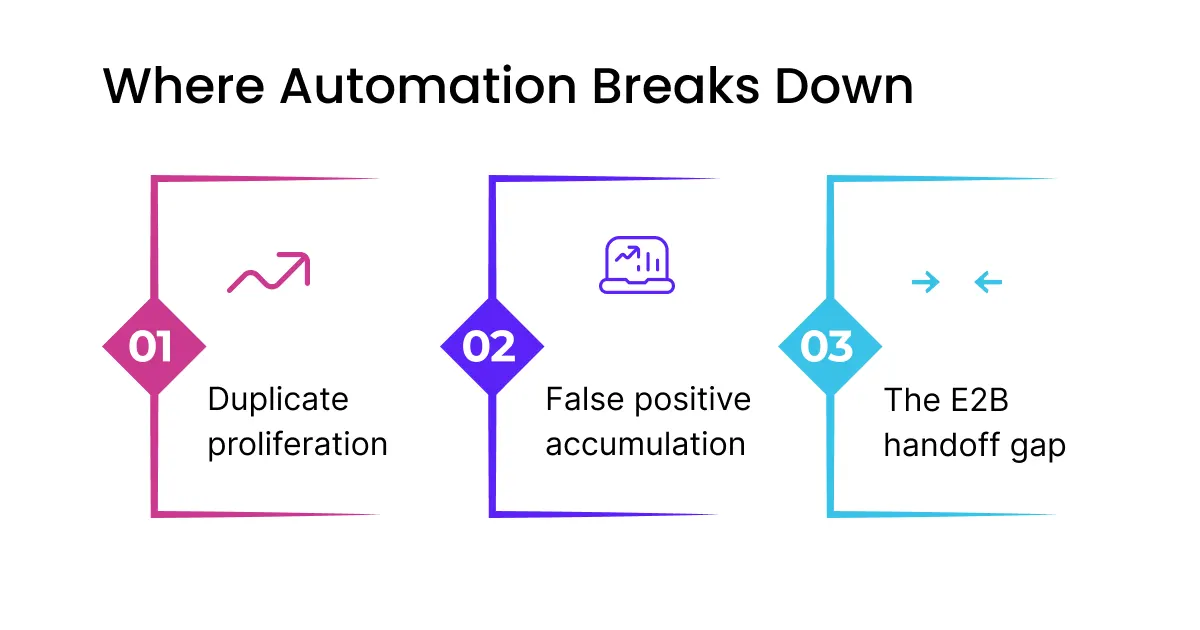
Duplicate proliferation
A single patient case can appear as a conference abstract in March, a full journal article in June, and a cited case in a systematic review by September. Without cross-document matching in place, different team members may each create a separate ICSR for what is actually one patient.
A 2024 scoping review in BMJ Open found that 11% of literature-sourced reports in the WHO pharmacovigilance database were duplicates, compared to a 2.5% duplicate rate across all other reporting channels. Duplicate ICSRs inflate case counts, distort signal detection, and waste investigative resources.
False positive accumulation
Broad keyword searches surface pharmacokinetic studies, in vitro research, and review articles that mention a drug without any reportable adverse event content.
As per the EMA’s 2024 signal data, even downstream of literature screening, the large majority of retrieved information does not lead to validated findings. Without intelligent pre-screening, PV professionals spend significant time on articles that should never have been included in the review process.
The E2B handoff gap
Even after a valid ICSR is identified, transferring data to the safety database is often done manually. Demographics, adverse event details, drug exposure information, and publication metadata are typed manually into safety databases such as Argus Safety or ArisGlobal. This creates transcription risk and leaves no automatic audit trail connecting the source article to the final case record.
What End-to-End Automation Actually Looks Like
Effective AI-powered literature monitoring for ICSR detection requires more than faster retrieval. Here is what each stage of a connected, end-to-end pipeline looks like in practice.
| Pipeline Stage | What It Does | Why Is It Important? |
|---|---|---|
| Multi-database search execution | Queries PubMed, EMBASE, regional databases, regulatory websites, and clinical trial registries simultaneously, handling syntax differences automatically and delivering a unified results view. | Removes hours of manual search recreation each week and eliminates inconsistent search strategies across platforms. |
| AI-powered triage and classification | NLP engines trained on pharmacovigilance terminology classify abstracts by ICSR relevancy before any human review. A 2025 systematic review in Research in Social and Administrative Pharmacy found externally validated AI models achieved 81.5% sensitivity and 79.5% specificity for ADR identification, outperforming internally validated models (78.1% sensitivity, 70.6% specificity). | AI handles volume-intensive screening. Human reviewers focus on validation and medical judgment. |
| Intelligent duplicate detection | Cross-references DOIs, normalises author names and journal abbreviations, and reads case narratives to catch same-case duplicates that DOI matching alone misses. The 2024 BMJ Open scoping review confirmed detection algorithms significantly outperform manual review for cross-publication matching. | Reduces duplicate ICSR creation at the source. While high-confidence matches are merged automatically, moderate-confidence cases are flagged side by side for human review, keeping reviewers in control of ambiguous decisions. |
| Direct API integration and E2B R3 case creation | Maps all extracted data, including demographics, adverse event terms, drug details, causality indicators, and publication metadata, into E2B R3-compliant ICSR case creation fields and transfers the case through direct API integration with safety databases. All field mapping, controlled vocabularies, and MedDRA coding are validated before production. | Automated signal detection from scientific literature is only complete when the signal flows into the safety database without manual transcription. This is the step most semi-automated systems skip. |
Building an Audit-Ready PV Literature Monitoring Process
During inspections, regulators focus not on whether AI was used, but on whether every AI-assisted decision is thoroughly documented and defensible. Achieving this level of transparency requires a clear distinction between tasks handled by AI and those that require human oversight.
- Screening, which involves determining which articles may contain safety information, is volume-intensive and rules-based. AI handles it consistently. Validation, which involves confirming that a specific article contains a reportable ICSR and approving the data that enters the safety database, requires qualified human review and sign-off. No automated system should create final case records without it.
- An inspection-ready implementation documents which steps are AI-assisted and which are human-verified, and it maintains complete audit trails for both. Under 21 CFR Part 11 and EU GMP Annex 11, audit trails must be secure, computer-generated, and time-stamped. They need to cover the full pathway from search execution through triage, human validation, and ICSR submission. In a properly integrated AI literature management workflow, this documentation is generated as part of normal operations rather than being assembled before an audit.
Clinevo’s Literature Management Platform: From Audit-Ready Design to Operational Reality
Clinevo’s Literature Management platform is purpose-built for pharmacovigilance — not repurposed from academic reference management tools.
At its core, the platform is an AI literature management system designed to handle the full surveillance pipeline. Its NLP engine is trained specifically on PV terminology – drug names, adverse event descriptions, causality language, and MedDRA coding patterns – enabling it to distinguish between a pharmacokinetic study that merely mentions a drug and a case report that contains a reportable adverse event. This is the distinction that rule-based keyword screening cannot reliably make, and it is where the AI capability delivers a measurable impact on false positive rates.
The duplicate detection layer goes beyond DOI matching. It applies AI-driven narrative analysis to identify same-patient cases that have been published in different formats across different journals (for e.g., a conference abstract, a full paper, and a cited case in a review ) all describing the same individual. Without this capability, each publication can generate a separate ICSR, inflating case counts and distorting signal detection.
The platform integrates directly with Argus Safety, ArisGlobal, and Clinevo Safety, ensuring that validated ICSRs are transferred without any manual re-entry.
- Each transfer includes comprehensive audit trails, capturing article metadata, patient details, adverse event information, and source documentation.
- It generates E2B R3-compliant XML output, fully aligned with current FDA and EMA submission requirements.
- Browser-based access enables global team collaboration across time zones.
- Built-in compliance with 21 CFR Part 11, Annex 11, GxP, and GDPR means documentation is generated throughout the process, not assembled in preparation for an audit.
When to Consider a Purpose-Built PV Literature Platform
Moving from manual literature monitoring to end-to-end AI literature management is a pharmacovigilance operations decision, not just a technology one. The core question is where your team’s expertise is being applied. Is it being used for data collection and transcription, or for signal evaluation and causality assessment? If your team is spending most of its time on retrieval and screening rather than medical analysis, or if your ICSR creation workflow still involves manual data entry, it may be time to look at what a purpose-built AI-enabled literature management platform can offer.
Frequently Asked Questions
Automated retrieval pulls articles from databases on a schedule. End-to-end automated surveillance extends that by adding AI triage, duplicate detection, ICSR identification, and direct E2B R3-compliant transfer into your safety database, with human validation built in at the right stages. Most teams have retrieval in place. Far fewer have the full pipeline connected.
The system combines DOI cross-referencing, author name normalisation, journal standardisation, and case narrative analysis. It can identify that a conference abstract and a full journal article describe the same patient even when their DOIs, author lists, and journal names are all different. High-confidence matches are merged automatically. Borderline cases are presented side by side for human review.
Inspectors want records showing which databases were searched and when, what search terms were used, how screening decisions were made, which articles were excluded and why, and how each validated ICSR was transferred to the safety database. An integrated automated system generates all of this as part of normal operations, in real time.
In Clinevo's platform, E2B R3 mapping is part of the core architecture. It is validated before deployment, not configured per case. The system handles controlled vocabularies, null flavors, and MedDRA coding consistency as standard.
Yes. The platform connects directly to Argus Safety, ArisGlobal, and Clinevo Safety via API. It can run in parallel with your existing processes during validation, so there is no disruption to ongoing literature monitoring or regulatory submissions.