





The Migration Narrative You Hear vs. Reality
The conventional narrative around pharmacovigilance database migration is straightforward: extract data from the legacy system, validate it during a transition window, and load it into the new platform. Timeline estimates range from three months for smaller operations to longer periods for complex portfolios. Organizations often approach these projects expecting a straightforward technical handoff.
In practice, migration projects frequently encounter hidden challenges that extend timelines, consume unexpected resources, and create compliance documentation burdens. The problem is not that vendors are dishonest about timelines – it is that the operational complexity of managing historical Individual Case Safety Report (ICSR) data during a transition reveals itself only after a migration plan is finalized.
Five Hidden Realities of Safety Database Migration
1. Historical ICSR Data Is Rarely as Complete as Expected
The assumption that legacy data is ready for transfer is one of the earliest migration myths to encounter reality. Pharmacovigilance systems accumulate data over years, often under different coding standards, metadata architectures, and compliance frameworks. When organizations prepare historical ICSRs for migration, they discover that:
- Metadata does not migrate. Audit trails, submission history, and case-level documentation from the source database are not automatically transferred.Organizations must manually reconstruct historical records or accept gaps in traceability - neither option is straightforward.
- Data fields have inconsistent mapping. Source systems define fields differently from target systems. A clinical trial identifier coded one way in the legacy database may not align with the target system's data structure, requiring manual field-by-field reconciliation.
- Validation gaps accumulate silently. Legacy data often contains inconsistencies - cases missing narratives, incomplete patient demographics, or drug information coded under deprecated terminology - that went undetected because they did not impede daily operations. Migration forces an audit of this historical data.
For organizations with fewer than 150 cases, manual migration (where each ICSR is manually recreated in the target system) remains viable, though labor-intensive. For larger case volumes, the resource burden becomes prohibitive, necessitating technical or hybrid E2B-based migration approaches.
2. MedDRA Versioning Introduces Silent Data Quality Risks
The Medical Dictionary for Regulatory Activities (MedDRA) is updated annually with significant structural changes. A single update can introduce 1,000 or more change requests, affecting preferred term definitions, hierarchical relationships, and terminology alignment. During migration, organizations face a fundamental question: should historical cases be re-coded to the current MedDRA version, or retained in their original version?
Neither answer is straightforward:
- Recoding historical data introduces inconsistency into analyses. When MedDRA terms are merged, split, or renamed, re-coding changes the frequency distribution of adverse events, potentially altering the appearance of historical signal data and complicating retrospective safety assessments.
- Retaining legacy versions creates a fragmented terminology landscape. Cases coded across multiple MedDRA versions cannot be aggregated cleanly for signal detection or periodic reporting, requiring version-aware analytics that add complexity to ongoing operations.
- Version-aware mapping requires technical infrastructure to track term evolution across versions and normalize data for analysis. This hybrid approach demands governance and ongoing maintenance.
Organizations often discover this challenge only after agreeing to migration timelines, when the full scope of historical re-coding (or version management infrastructure) becomes apparent.
3. Duplicate Detection During Migration Is Both Critical and Imperfect
When ICSR data spans multiple source systems or has accumulated over years, duplicate cases frequently exist. A single adverse event may have been entered multiple times, or follow-up information for an existing case may have been recorded as a separate entry. During migration, identifying and merging duplicates before transferring data to the new system is essential – but detection is not automatic.
One of the most common failures in literature deduplication is conflating two cases that look similar but require different actions.
The Duplicate Problem
Literature-sourced ICSRs duplicate at significantly higher rates than spontaneous reports. A scoping review of pharmacovigilance databases found that 11% of literature-sourced safety reports were duplicates, compared to only 2.5% across other reporting channels. During migration, these duplicates are exposed and must be resolved. A single patient case may appear as a conference abstract, a full journal publication, and a cited case across different sources – each potentially entered separately into the legacy system.
Most organizations employ documented reconciliation processes using DOI matching, author name normalization, and case narrative analysis. However, the process is labor-intensive and requires subject matter expertise to distinguish between genuinely distinct reports and variations of the same case.
4. E2B(R3) Compliance During Transition Creates Validation Bottlenecks
Regulatory authorities now mandate E2B(R3) format for ICSR submissions to EudraVigilance and other centralized systems. Migration provides an opportunity to standardize historical data to the E2B(R3) specification, but the process is complex and time-consuming.
E2B(R3) compliance requires:
- Accurate mapping of all required data elements from source systems to E2B-compliant fields
- Validation that controlled vocabularies (MedDRA codes, WHO Drug codes) align with submission requirements
- Verification that null values, missing data, and optional fields meet regulatory expectations
- Testing that all cases can be converted to E2B-compliant XML without data loss or structural errors
E2B(R3)-compliant data significantly improves case-finding in pharmacovigilance analysis. Algorithms searching data that adheres strictly to the E2B format achieve 91% recall, compared to 75% recall in general, unstructured databases. This benefit creates migration pressure: organizations want historical data converted to E2B(R3) to improve future analytics, but conversion itself is labor-intensive and error-prone.
5. GxP Compliance During Transition Remains a Blind Spot
Migration projects are inherently disruptive. For a defined period, the legacy system may be frozen to prevent data changes, the transition environment is being populated, and the new system is being validated. During this window, regulatory obligations do not pause: pharmacovigilance teams must continue processing new adverse event reports, managing expedited submissions, and responding to regulatory inquiries. Maintaining GxP compliance – complete audit trails, timely case assessments, and regulatory submission deadlines – while executing a parallel system transition is operationally challenging.
Organizations often underestimate the resources required to manage this parallel operation. Case processors must work across systems, validation workflows must remain intact, and compliance documentation must cover both the legacy system and the migration process itself.
The True Cost of Migration Failures
When migration projects encounter these hidden challenges, costs extend far beyond initial estimates. Organizations frequently discover that:
- Data cleansing extends timelines. Identifying and resolving data quality issues, duplicate cases, and field mapping inconsistencies typically requires significantly more effort than anticipated. For large case volumes, this phase alone can extend project timelines by months.
- Metadata reconstruction becomes a compliance burden. When audit trails and submission history cannot be automatically transferred, organizations must either manually reconstruct historical records (time-intensive) or document and justify known data gaps (compliance risk).
- Signal detection accuracy can degrade temporarily. If MedDRA coding is inconsistent across versions or historical data contains uncorrected duplicates, downstream signal detection algorithms may produce less reliable results during the post-migration period. Organizations may need to delay critical safety analyses while data quality is restored.
- Regulatory inspections during or shortly after migration create additional scrutiny. FDA and EMA inspectors examine data integrity controls closely. A migration project, if not meticulously documented, can raise questions about how data integrity was maintained during the transition.
Building a Migration Plan That Actually Works
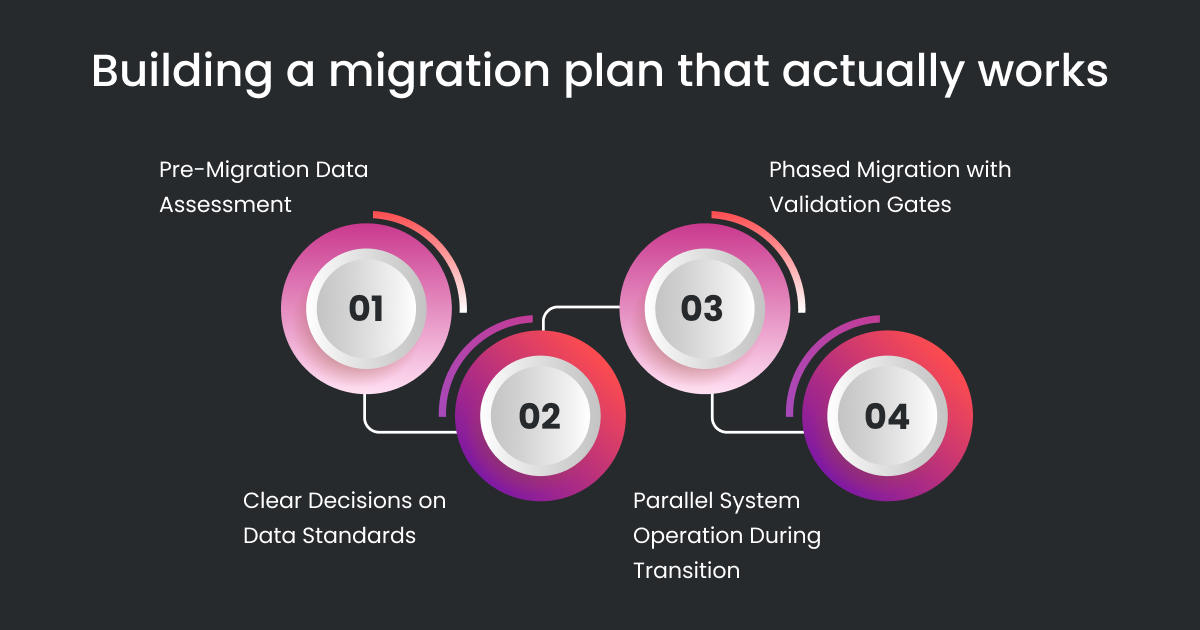
Successful pharmacovigilance database migrations share common characteristics:
Pre-Migration Data Assessment
Before any technical work begins, organizations should conduct a comprehensive audit of legacy data. This assessment should identify:
- Completeness of ICSR fields (which cases are missing critical data)
- Distribution of MedDRA versions used across historical cases
- Potential duplicate cases or follow-up relationships not yet formalized
- Gaps in audit trails or submission documentation
- Data quality issues (inconsistent drug coding, missing narratives, etc.)
This assessment allows teams to estimate the true scope of data remediation work and adjust timelines accordingly.
Clear Decisions on Data Standards
Organizations should make explicit decisions about MedDRA versioning, E2B(R3) compliance, and metadata reconstruction before migration begins. These decisions should be documented and communicated to all stakeholders, including regulatory affairs teams, who will need to defend the migration approach during future inspections.
Phased Migration with Validation Gates
Rather than a single “big bang” migration, phased approaches reduce risk. Organizations can migrate subsets of data (by product, by year, or by case type), validate each batch thoroughly, and identify issues before moving to the next phase. This approach provides time to adjust methodology and prevents failures from affecting the entire data set.
Parallel System Operation During Transition
Maintaining the legacy system in a read-only state during transition allows teams to continue accessing historical data for reference while the new system is being populated and validated. This approach prevents operational gaps but requires careful data governance to ensure a single source of truth is maintained.
How Clinevo Safety Database Addresses Migration Realities
The Clinevo Safety Database is purpose-built to address the core challenges that emerge during pharmacovigilance database transitions:
Advanced Data Quality Validation at Intake
Clinevo’s real-time data quality validation with anomaly detection algorithms identifies incomplete, inconsistent, or suspicious data entries instantly. During migration, this capability allows organizations to quickly surface and remediate data quality issues before they become entrenched in the new system. The platform improves data integrity by 98% through automated validation – a critical advantage when importing historical data that may contain legacy inconsistencies.
Intelligent Duplicate Detection During Import
The platform’s AI-based duplicate detection uses intelligent matching algorithms to identify potential duplicate cases during data import. Rather than requiring manual case-by-case review, the system flags probable duplicates with confidence scores, allowing pharmacovigilance teams to make informed merge decisions. This approach saves up to 40% of case processing time compared to manual duplicate management.
Automated E2B(R3) Validation and Compliance
Clinevo’s database-integrated gateway configurations include automated E2B validation before any case enters submission workflows. The system performs field-level validation, controlled vocabulary verification, and message structure checks internally, catching errors before they reach regulatory gateways. This pre-submission validation protects data integrity and prevents rejection cycles that delay compliance timelines.
Complete Audit Trails and Compliance Documentation
Every action within Clinevo Safety Database generates timestamped, tamper-evident audit trail entries that meet 21 CFR Part 11 and EU GMP Annex 11 requirements. During migration, this creates an unbroken compliance record: historical data is imported with documented evidence of source, transformation steps, validation results, and human oversight. This level of documentation preparation significantly reduces regulatory risk during future inspections.
Workflow Automation to Maintain Operations During Transition
Intelligent case routing and workflow automation reduce the operational burden of processing cases while a migration is underway. As teams divide attention between legacy system operations and new system validation, automation handles routine case triage, data routing, and SLA tracking. This allows safety operations to continue without degradation during the transition window.
The Reality of Migration: Plan Comprehensively, Execute Deliberately
Safety database migration is not simply a technology deployment. It is a comprehensive operational and compliance undertaking that requires clear decision-making about data standards, sufficient time for pre-migration assessment, and systems that enforce data quality throughout the process.
Organizations that approach migrations with realistic expectations – acknowledging the hidden complexities discussed above – and that implement data validation, duplicate detection, and compliance controls from the start experience significantly fewer post-migration issues. The upfront investment in thorough planning, pre-migration data assessment, and automated quality controls pays dividends in reduced timeline overruns, lower compliance risk, and operational continuity.
Frequently Asked Questions
Recoding decisions should be made explicitly in your migration plan, with input from regulatory affairs, medical, and IT teams. If you choose to recode, document the methodology and impact analysis - regulators will ask how this decision affected historical signal data. If you retain legacy versions, implement a version-aware analytics infrastructure. There is no universally correct answer, but the choice must be deliberate and documented.
Pre-migration data assessment should identify cases with missing critical fields (narratives, patient demographics, etc.). For each category of missing data, document whether the information is truly unavailable or simply not captured in the legacy system. Develop a remediation plan: some data may be recoverable from source documents, some may require documented justification for acceptance as-is. Never migrate incomplete data in isolation; document the decision and rationale for each category of missing data.
Post-migration duplicate discovery creates retroactive data governance challenges. A robust pre-migration duplicate detection process (using documented reconciliation methodology) prevents this scenario. However, if duplicates are discovered post-migration, document the merger process, update affected signal detection analyses, and assess regulatory impact. The goal is to prevent post-migration discovery by being thorough upfront.
Migration should not interrupt case processing or regulatory submission workflows. Maintain parallel systems where necessary: the legacy system continues operating for new case intake, validation workflows continue across both systems, and submission timelines are honored regardless of migration status. Clearly document which system is authoritative for each type of operation during the transition period. This adds operational complexity but is necessary to maintain compliance obligations.
Manual migration for cases under 150 typically takes three to four months, though more complex migrations with large case volumes, E2B(R3) compliance requirements, and historical data remediation can extend significantly longer. Case volume, data quality, MedDRA versioning decisions, and the need for complete audit trail documentation are the primary factors affecting the timeline. Underestimating these variables consistently leads to schedule overruns.