




There is a quiet but significant gap widening in drug safety operations today. On one side, some organizations have modernized their pharmacovigilance infrastructure, built around intelligent automation, real-time analytics, and seamless regulatory connectivity. On the flipside, many teams still wrestle with legacy systems, manual case processing workflows, and the constant anxiety of submission deadlines that leave little room for error. The pharmacovigilance database sits at the center of this divide. It is not simply a repository for adverse event records but the operational backbone of an entire drug safety program. And yet, for many life sciences organizations, it remains one of the most underinvested, most outdated components of the broader technology stack.
As case volumes expand across clinical development and post-marketing surveillance, life sciences companies face mounting pressure to improve case processing efficiency, ensure E2B validation and reporting accuracy, and meet global regulatory compliance in pharmacovigilance without inflating operational costs. The traditional database model, built for storage and static workflows, is no longer sufficient for this level of complexity.
To close this widening gap, the pharmacovigilance database must evolve from a passive system of record into an intelligent operational engine. The inclusion of AI in drug safety – such as the implementation of NLP-driven classification, Individual Case Safety Report (ICSR) automation, and real-time compliance monitoring – is redefining what a modern pharmacovigilance software platform can truly deliver.
Why the Traditional Safety Database Was Always Fighting Upstream
Understanding why the modern pharmacovigilance database looks so different from its predecessors requires revisiting what legacy systems were designed to do and where those design assumptions broke down under the weight of today’s regulatory and operational demands.
Legacy pharmacovigilance software was built for a different era. The volume of adverse event data was smaller. The regulatory landscape was less fragmented. And the expectation of speed – with most global health authorities now demanding expedited reporting within tight windows – was simply not what it is today.
Traditional safety databases were designed primarily as case storage and routing systems. A case would arrive, a trained professional would manually review and code it, a writer would populate the narrative, and a separate team would handle the submission. Each step was largely disconnected from the next, held together by spreadsheets, emails, and institutional memory.
The problems this creates are well-documented in the industry. Duplicate cases slip through without robust deduplication logic. Coding inconsistencies between reviewers lead to downstream signal noise. Submissions get delayed because E2B validation errors are caught late. And the dashboards, when they exist at all, show you what happened yesterday rather than what is happening right now.
None of this is acceptable when patient safety is compromised.
Five core demands on a modern PV database:
- Enable AI automation in pharmacovigilance case processing
- Support seamless E2B validation and ICSR reporting
- Provide real-time PV dashboards and SLA insights
-
Integrate with signal management platforms.
- Maintain inspection-ready compliance across regions
AI Automation in Pharmacovigilance Case Processing: What It Actually Looks Like
The phrase “AI in pharmacovigilance” is often used broadly. It is important to define what meaningful automation truly involves.
Intelligent Case Intake
At intake, AI parses unstructured adverse event reports from emails, PDFs, call center transcripts, patient portals, and literature sources. It extracts core elements such as reporter details, suspect products, event narratives, seriousness criteria, and patient demographics without manual transcription. Each extracted ICSR is structured against defined data fields before entering the processing queue, reducing downstream rework and improving data completeness from the point of entry. For organizations handling high case volumes, this significantly improves case processing efficiency.
Automated Duplicate Detection
AI-driven duplicate detection applies probabilistic matching to flag potential duplicate cases early. This is more than operational efficiency. Duplicate cases that slip through can distort signal detection and skew safety data. Identifying them upfront protects database integrity.
Smart Case Triage and Routing
Workflow automation further strengthens control. Cases are routed automatically based on seriousness, product, therapeutic area, and jurisdiction. Expedited reports trigger compliance alerts and submission tracking, while non-expedited cases follow predefined pathways.
Compliance Embedded by Design
Throughout the lifecycle, every action is logged within a validated, timestamped audit trail aligned with 21 CFR Part 11 and Annex 11 requirements.
Operationally, this shifts safety teams away from repetitive administrative tasks and toward medical review, signal assessment, and regulatory decision-making. That shift is where real value emerges.
How NLP Helps Adverse Event Classification Go Beyond Simple Keyword Matching
Natural language processing is reshaping how adverse events are interpreted and classified within modern pharmacovigilance databases.
Interpreting Real-World Safety Narratives
Natural language processing allows a pharmacovigilance database to understand safety narratives rather than simply scan for keywords. Adverse events are often described in everyday language, incomplete clinical phrasing, or translated text. These variations introduce ambiguity. An NLP-enabled system analyzes context, identifies suspect products and reactions, detects seriousness indicators, and interprets medical intent within the narrative. Based on this contextual understanding, the system proposes appropriate MedDRA preferred terms along with confidence scores for reviewer validation.
Improving Coding Consistency Across Markets
Structured NLP support accelerates classification while reducing variability. Large, distributed pharmacovigilance teams benefit from standardized coding suggestions, especially when processing cases across multiple countries and languages. Consistency in coding strengthens data integrity and supports regulatory compliance in pharmacovigilance, particularly when aggregated data feeds into signal detection and periodic reporting.
Strengthening Literature Surveillance
NLP also enhances literature monitoring by scanning scientific publications for potential adverse events and prioritizing relevant articles for review. Given the volume of daily scientific output, automated screening ensures emerging evidence is captured efficiently. This keeps the pharmacovigilance database aligned not only with spontaneous reporting but also with evolving clinical knowledge.
E2B R3 Compliance and Automated Regulatory Submissions in Drug Safety
Accurate, timely, and fully compliant electronic reporting is one of the most critical responsibilities within any modern pharmacovigilance program.
Why E2B R3 Accuracy Is Critical
E2B R3 is the current ICH standard for electronic adverse event reporting. It defines the structure and content requirements for Individual Case Safety Reports (ICSRs) submitted electronically to health authorities worldwide.
Most major regulatory authorities — including the US FDA, EMA, Health Canada, PMDA (Japan), and MHRA (UK) — require submissions in this format. Getting it right is not optional, and getting it wrong carries consequences that range from rejected submissions to regulatory action.
Submission Timelines Across Key Jurisdictions
Expedited ICSR reporting timelines vary by jurisdiction but converge on strict standards. The FDA requires submission of serious and unexpected adverse reactions within 15 calendar days of receipt. The EMA applies the same 15-day window for suspected unexpected serious adverse reactions (SUSARs) in clinical trials. PMDA and MHRA maintain similarly strict expedited reporting obligations for serious cases. For organizations operating across multiple jurisdictions, missing any one of these windows constitutes a compliance event — not merely an administrative delay.
Built-In E2B Validation Before Submission
A modern pharmacovigilance database should perform E2B validation internally before any submission reaches a regulatory gateway. Required fields must be complete, message structures accurate, and product and event coding aligned with authority-specific requirements. Catching errors only at the gateway level — or after submission — creates rework cycles that strain compliance timelines and safety team resources.
Automated Regulatory Connectivity
Automated regulatory submissions extend this control by connecting the safety database directly to multiple regional gateways through secure transmission protocols such as AS2. Once a case reaches the appropriate processing stage, submission can be initiated without manual file exports, format conversions, or separate tools. The system manages transmission, receives acknowledgments, and logs outcomes within the same platform where the case was processed.
Reducing Operational and Compliance Risk
End-to-end regulatory connectivity significantly reduces operational risk. Submission deadlines are tracked automatically. Overdue cases trigger compliance alerts. When a health authority requests follow-up or clarification, the complete case history remains immediately accessible within the same system. For organizations operating across multiple regulatory jurisdictions, this level of integration makes global pharmacovigilance both manageable and defensible.
Real-Time PV Dashboards and SLA Insights: Knowing Your Program's Health at a Glance
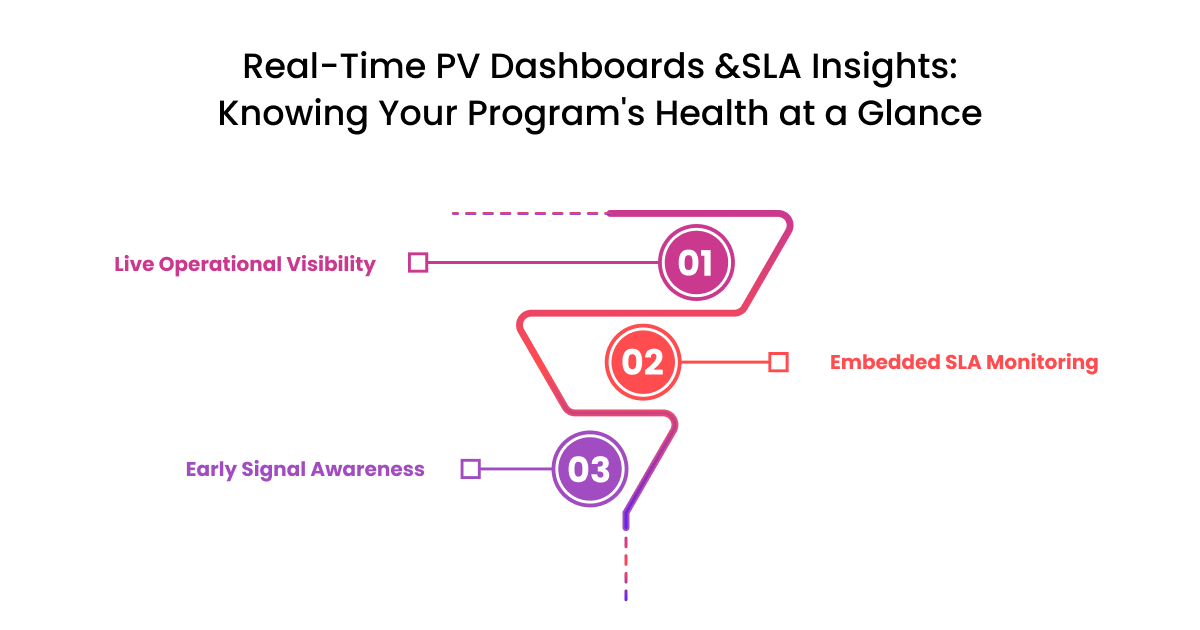
Effective pharmacovigilance oversight depends on real-time visibility into operational performance and compliance status.
Live Operational Visibility
One of the most underappreciated strengths of a modern pharmacovigilance database is its reporting layer. PV leadership requires insight not only into completed cases, but into the live status of every case in the processing pipeline. Real-time dashboards surface case volumes by product, seriousness, processing stage, and jurisdiction. They highlight cases approaching SLA thresholds before breaches occur and provide a consolidated view of submission compliance across health authority obligations. Drill-down capabilities enable deeper operational analysis when needed.
Embedded SLA Monitoring
The importance of SLA tracking in pharmacovigilance is substantial. Expedited reports for serious and unexpected adverse reactions are governed by strict timelines. A 15-day FDA submission filed late is not merely a delay — it represents a compliance event with potential regulatory consequences. Embedding SLA monitoring directly within the database reduces reliance on external tracking tools and strengthens proactive compliance management.
Early Signal Awareness
Advanced analytics within the PV database also support signal management integration. When event-product combinations begin trending upward, integrated detection tools can flag patterns for medical review before periodic aggregate analysis. This capability enables a more responsive and controlled safety surveillance strategy across the product portfolio.
The Integration Challenge: Connecting PV Systems With Literature and Signal Management
Fragmented safety systems remain a persistent challenge in pharmacovigilance. Many organizations operate separate platforms for case processing, literature monitoring, signal detection, and aggregate reporting, with limited real-time data exchange. This separation creates risk. Literature findings may not align seamlessly with spontaneous case data. Aggregate reports require manual reconciliation. Signal detection outputs may lag behind current case activity. The result is inefficiency and potential inconsistency.
Consider a common scenario: an NLP-powered literature screening tool identifies a new suspected adverse reaction in a recently published case study. Because the literature platform is separate from the safety database, that finding is not automatically cross-referenced against existing ICSRs in the case database. A safety officer must manually compare the two (either hours or days later). By the time the pattern is confirmed and escalated, the signal has been active for longer than it should have been, and the reconciliation work needed to demonstrate regulatory responsiveness adds cost and delay to what should have been an automated handoff.
This is the real cost of integration gaps: not just inefficiency, but delayed safety oversight.
A truly integrated pharmacovigilance database connects case data, literature automation, signal management, and reporting within a unified environment. When these functions draw from the same data foundation, safety oversight becomes more coherent and responsive. Inspection readiness also improves significantly — auditors reviewing an integrated system encounter a single, coherent data trail rather than the reconciled outputs of disconnected platforms.
Organizations evaluating pharmacovigilance software should examine how well the platform integrates across these domains. Integration is not a peripheral feature. It determines whether pharmacovigilance operates as a coordinated system or as a set of disconnected processes.
A Pharmacovigilance Database Built for the Demands of Modern Drug Safety
Clinevo Technologies has designed its pharmacovigilance database on a clear premise: compliance and efficiency should operate together, not in conflict. The Clinevo Safety platform brings case intake, AI-driven processing, E2B R3-compliant ICSR submissions, real-time analytics, and signal management into a unified environment.
Built primarily for pharmaceutical companies, life sciences organizations, biotech firms, and CROs. Configurable workflows, automated SLA tracking, and reliable multi-jurisdiction regulatory submissions through integrated gateway connectivity are core to its architecture.
Inspection readiness is a standout feature of the platform – audit trails are timestamped and tamper-evident, ICSR case histories are retrievable on demand, and submission records are maintained within the same environment where cases were processed. For organizations subject to FDA, EMA, or PMDA oversight, this level of documentation coherence is not optional.
Its architecture emphasizes usability and scalability. Teams can become productive quickly, while the underlying technology remains streamlined to reduce long-term complexity. Continuous AI enhancements ensure the system evolves alongside regulatory and operational demands.
For organizations reassessing their pharmacovigilance software strategy, Clinevo offers a modern alternative designed to reduce friction while strengthening global drug safety compliance.
If your safety infrastructure is due for a strategic upgrade, now is the time.
Frequently Asked Questions
AI supports automated data extraction from structured and unstructured sources, suggests medical coding, flags duplicates, and performs validation checks. This reduces repetitive manual entry while improving consistency, traceability, and overall ICSR quality across global safety operations.
Traditional systems rely heavily on manual workflows and static reporting. AI-powered pharmacovigilance software incorporates machine learning, NLP-driven classification, automated validations, and predictive analytics to enhance efficiency, accuracy, and real-time decision support in drug safety operations.
NLP models can process large volumes of unstructured data consistently and rapidly, applying contextual analysis to identify suspect products, event terms, and seriousness indicators that simple keyword matching would miss. While human medical judgment remains essential for final review, NLP improves classification consistency and reduces inter-reviewer variability — particularly in high-volume literature and narrative case intake environments spanning multiple languages.
Automated E2B validation performs internal checks on required fields, message structure, and coding alignment before a submission reaches any regulatory gateway. Errors caught internally are corrected within the same workflow, avoiding the rework cycles that gateway rejections create. This protects submission timelines and reduces the compliance exposure associated with late or incomplete ICSR filings.
Challenges include data standardization, system interoperability, validation requirements, and maintaining data integrity across platforms. Seamless integration requires careful configuration, regulatory alignment, and governance oversight to ensure inspection readiness. Organizations that delay addressing integration gaps often find the cost surfaces later — during audits, signal reconciliation exercises, or aggregate reporting cycles where manual bridging between disconnected systems becomes the visible bottleneck.