





For pharmacovigilance teams in the United States, the FDA Adverse Event Reporting System (FAERS) is the most familiar starting point for post-marketing safety surveillance. It is large, regulator-maintained, freely accessible through a public dashboard, and structured around the same ICH E2B(R3) framework that safety teams already use daily. None of that is in dispute.
What is increasingly in dispute is the quiet assumption that runs underneath many signal detection programs: that mining FAERS – on its own – is enough.
It is not. And the gap between what FAERS reliably surfaces and what is actually happening to patients in the real world has been widening for years. Underreporting, structural reporting biases, missing denominators, latency in spontaneous data, and entire categories of safety information that simply never arrive in FAERS combine to create what is best described as a structural blind spot. Drug safety teams that anchor their entire signal detection methodology to FAERS feeds are not detecting fewer signals because their analysts are less skilled. They are detecting fewer signals because they are looking at one data layer of a multi-layered problem.
This blog examines why FAERS data alone is not enough for reliable signal detection, what recurring failure patterns look like in practice, and how modern pharmacovigilance signal detection programs are widening their evidence base by building automated, multi-source workflows that include literature, case intake, and international ICSR repositories alongside FAERS.
Why FAERS Became the Default, and Why That Default Is Now a Liability
FAERS is foundational. The FDA receives more than two million adverse event reports annually through it, and the agency’s own clinical reviewers use FAERS as a primary source for identifying post-market safety concerns. A cross-sectional analysis of FAERS-derived signals from 2008 to 2019, published in The BMJ, identified 603 potential safety signals reported by the FDA over that period, with around 78% of resolved signals leading to some form of regulatory action.
That track record explains why FAERS sits at the center of so many signal management programs. The problem is what happens when teams stop there.
The same BMJ study found that, in a review of 82 FAERS-derived signals from 2014–2015, 76 were resolved. Among those with available literature, published research corroborated FDA regulatory actions in 29.8% (17/57) of cases, while none of the Sentinel Initiative assessments supported the FDA’s regulatory actions. In other words, even at the regulator level, FAERS-only signals are routinely actioned without an independent confirmatory trail. For sponsors building their surveillance on FAERS extracts alone, that gap is even wider.
The Five Structural Blind Spots of FAERS-Only Surveillance
The biggest limitations of relying only on spontaneous reporting systems like FAERS are not new, but they have become more consequential as case volumes, product portfolios, and regulatory expectations have all expanded. They fall into five recurring patterns.
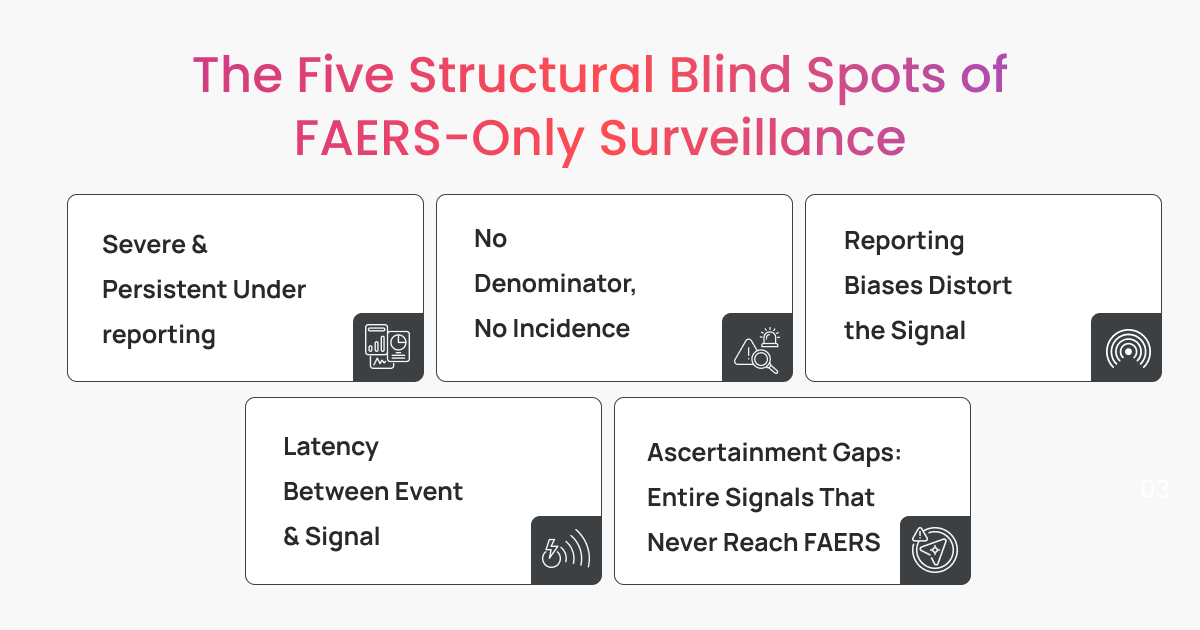
1. Severe and Persistent Underreporting
Spontaneous reporting captures a small fraction of adverse drug reactions that actually occur. The most widely cited systematic review on this question examined 37 studies across 12 countries and reported a median underreporting rate of 94%, with an interquartile range of 82 to 98%. Even for serious or severe ADRs, the median underreporting rate sat at 85%.
The FDA itself acknowledges this directly: it does not receive reports for every adverse event or medication error that occurs with a product, and many factors influence whether an event is reported at all.The implication is straightforward. A signal detection program that treats FAERS as a complete record of post-market safety experience is, by definition, working from a partial view.
2. No Denominator, No Incidence
FAERS captures reports, not exposed populations. Without information on the total number of patients exposed to a product, true incidence rates cannot be calculated from FAERS data alone. Disproportionality measures such as the Proportional Reporting Ratio (PRR) and Reporting Odds Ratio (ROR) help flag uneven distributions of drug-event pairs within the database, but they do not answer the question regulators and medical teams actually need answered: how often does this event occur in patients who take this drug?
Active surveillance systems built on claims and electronic health record (EHR) data, such as the FDA’s Sentinel Initiative, which now has over 425 million person-years of observation time, are designed precisely to answer that question, and they routinely surface or quantify risks that FAERS-only analyses cannot.
3. Reporting Biases Distort the Signal
Spontaneous reporting is a self-selected channel, and self-selection introduces systematic bias.
- Notoriety bias: Once a regulatory alert, label change, or media event raises awareness of a possible association, reporting for that event tends to spike, sometimes independent of any change in the underlying clinical risk. Studies of FAERS data following safety alerts have documented increased reporting and shifts in disproportionality estimates after such events.
- Channel bias: A single report can come from a healthcare professional, a patient, a lawyer, or a manufacturer. The level of clinical detail, causality assessment, and follow-up often varies sharply across these sources, even for the same event.
None of these biases invalidates FAERS as a hypothesis-generating resource. They do, however, mean that signal strength derived from FAERS-only analyses can fluctuate for reasons that have little to do with patient risk.
4. Latency Between Event and Signal
Spontaneous data is slow data. A 2015 analysis published in PLOS ONE examining ADR signal detection in FAERS found that the time to detect a signal after a drug’s release in the United States ranged from roughly two to ten months for already-known ADRs and from 19 to 44 months for unknown ADRs.
For a serious, unexpected safety signal, that gap is the difference between an issue identified in months and one identified in years. Reasons include the time taken for a clinician to suspect causality, file a report, route it through a manufacturer or directly to the FDA, and accumulate enough disproportionality for the signal to clear a detection threshold.
5. Ascertainment Gaps: Entire Signals That Never Reach FAERS
The most overlooked limitation of FAERS-only surveillance is what never enters the system in the first place. Adverse events surface in many places long before, or instead of, arriving as a formal FAERS submission, including:
- Conference abstracts and full journal articles published in PubMed and EMBASE.
- Patient calls into Medical Information Call Centres (MICC), product complaints emails, web portals, and patient support program intake forms.
- Reports collected by other regulatory authorities, including those routed to EudraVigilance in the European Union and to the WHO global database, VigiBase, which now contains more than 40 million ICSRs from over 160 countries.
- Real-world data from EHRs, claims databases, and active surveillance programs.
Each of these is a legitimate, often earlier source of safety evidence. None of them is FAERS.
Where the Signals FAERS Misses Actually Live
The shift from FAERS-only mining to multi-source signal detection is not about adding more dashboards. It is about treating safety data as a single connected surveillance environment in which different sources contribute different kinds of evidence to the same drug-event analysis.
A modern, automated signal detection workflow should do four things consistently:
- Ingest data from multiple ICSR sources in a unified structure. FAERS, EudraVigilance, VigiBase exports, and the organisation’s own internal safety database should feed the same analytic environment, with deduplication and case linkage handled automatically rather than manually reconciled across spreadsheets.
- Apply a recognised set of statistical methods, not just one. Disproportionality analysis using PRR, ROR, EB05, EBGM, and chi-square should run together, so signal strength is evaluated through more than a single lens. Threshold mapping should be configurable rather than fixed, to reduce confounding and false positives.
- Stratify by therapeutic area. Performing disproportionality within therapeutic strata (oncology, cardiology, immunology, etc) reduces noise from cross-area comparisons and limits competition bias.
- Connect signals to upstream and downstream context. A signal flagged in disproportionality should be traceable back to the source ICSRs, the literature evidence, the case intake records, and the relevant therapeutic-area background, all in one place.
This is the operational shift that separates a passive FAERS query from an inspection-ready signal management programme.
How Clinevo Signal Management Closes the FAERS-Only Blind Spot
Clinevo Signal Management is built specifically for this multi-source environment. It is automation-driven rather than rule-driven, and it is designed to integrate with the rest of the OnePV ecosystem so that FAERS, internal safety database records, literature surveillance outputs, and case intake data feed a single signal detection layer.
Three design choices matter most for teams looking to move beyond FAERS-only surveillance:
- Multi-source ICSR fusion. The platform integrates with FAERS, EudraVigilance, WHO VigiBase, and any internal safety database through database-to-database linking and intelligent data fusion, allowing signals to be evaluated across regulatory and non-regulatory sources within governed access controls.
- Comprehensive automated statistical analytics. Disproportionality is computed using PRR, ROR, EB05, EBGM, and chi-square in parallel, with propensity-score-adjusted automated threshold mapping designed to improve specificity and reduce false positives in large-scale screening.
- Therapeutic-area-aware and graph-based analytics. Signal rules can be configured by therapeutic area to limit cross-area noise, and a graph-based analytical layer models drugs, events, patients, and risk factors as an interconnected network. Each detected signal is traceable along a graph path showing which drugs, events, patients, and sources contributed to it, supporting transparent, regulator-friendly explanations during inspections.
Because Clinevo Signal Management sits in the same OnePV environment as Clinevo Case Intake (built around GenAI-enabled extraction from unstructured intake channels) and the Clinevo Literature Management Platform (an AI-driven literature surveillance system trained on PV terminology), the connection between upstream signal sources and downstream signal detection is built into the architecture, not bolted on through manual reconciliation. AI in case intake and literature automation feeds richer, cleaner data into the automation-based signal detection layer, so analysts spend their time on signal evaluation rather than on chasing data across disconnected systems.
From Single-Source Mining to Inspection-Ready Surveillance
FAERS is not the problem. Treating FAERS as the whole of post-market safety surveillance is.
Underreporting, missing denominators, biased reporting, latency, and ascertainment gaps all push real safety signals outside the boundary of any single spontaneous reporting database. The pharmacovigilance teams that detect signals earliest are the ones whose signal detection methodology is built across data layers, not within one. Literature monitoring, case intake, and international ICSR sources are not optional adjuncts in that methodology. They are the layers where signals first appear.
If your team’s signal detection programme is anchored to FAERS extracts and supplemented by manual reconciliation across other sources, the case for moving to a unified, automated, multi-source environment is no longer theoretical. It is operational.
Frequently Asked Questions
FAERS captures spontaneous reports, which are self-selected and incomplete by design. A widely cited systematic review estimated a median underreporting rate of 94% across studies of spontaneous reporting systems. FAERS also lacks information on the total exposed population, which means true incidence rates cannot be calculated from it alone. Combined with reporting bias and the latency between event and report, these structural limitations mean that FAERS-only signal detection consistently misses or mis-strengthens real safety signals.
The most consistent issues are severe underreporting, the absence of a denominator for incidence calculation, channel and notoriety biases that distort signal strength, latency in signal detection (often 19 to 44 months for previously unknown ADRs), and ascertainment gaps where adverse events appear in literature, intake channels, or international databases but never enter FAERS in a usable form.
By widening the surveillance footprint. This typically means combining FAERS with EudraVigilance and VigiBase data, integrating automated literature surveillance into the signal pipeline, applying automation-based extraction at the case intake layer to surface unstructured information earlier, and using active-surveillance datasets such as Sentinel for incidence-based questions. The key shift is treating these as inputs into one signal detection environment rather than separate workflows.
Often, yes. Published case reports and conference abstracts can describe events months or years before equivalent ICSRs are formally submitted to FAERS, and a peer-reviewed analysis showed that combining FAERS with biomedical literature improved the precision of top-ranked drug-event signals by approximately 13.8-fold compared with FAERS-only ranking. Case intake data is even earlier, since adverse events arrive at the manufacturer through calls, emails, and web portals before a formal ICSR is generated.
A practical baseline includes EudraVigilance (and EVDAS for disproportionality), WHO VigiBase, the organisation’s own internal safety database, structured outputs from automated literature surveillance, structured intake from MICC, email, and web portal channels, along with active surveillance datasets such as Sentinel for incidence-based confirmation (where appropriate). The value comes not from collecting these in parallel, but from connecting them through a single, automated signal detection environment.