





The pharmacovigilance software market was valued at approximately USD 2.09 billion in 2025 and is projected to reach USD 5.06 billion by 2035, growing at a CAGR of 9.24%.That growth reflects a genuine operational shift, not a commercial trend. Regulatory reporting obligations have expanded across every major jurisdiction. Case volumes have grown steadily. And the expectation that safety teams will process and submit high-quality ICSRs within tight timeframes has become firmly established across the FDA, EMA, PMDA, and MHRA.
The decision to invest in PV software is, therefore, rarely about whether to act. It is about which platform to select, how to evaluate it against your organization’s operational reality, and how to avoid the implementation pitfalls that can derail even well-planned programs.
This guide is written for decision-makers actively evaluating pharmacovigilance software platforms in 2026, and who need a structured way to separate vendor marketing from operational reality. It covers what PV software is, what features actually matter, the cloud vs on-premise question, what implementation realistically looks like, and how to build a defensible vendor shortlist.
What Pharmacovigilance Software Actually Does
Pharmacovigilance software, also referred to as a drug safety database or PV database, is the system that captures, processes, codes, validates, and submits adverse event data to regulatory authorities across the lifecycle of a medicinal product. It is the technical backbone of every regulated drug safety program.
At a working level, a modern PV database performs five functions:
- Case intake Captures Individual Case Safety Reports (ICSRs) from spontaneous reports, call centers, email, web portals, literature, partners, and clinical trials.
- Case processing Codes adverse events using MedDRA, applies WHODrug for product coding, performs duplicate checks, and routes cases through medical review and quality control.
- Regulatory submission Generates ICH E2B(R3) compliant XML files and transmits them to authority gateways, including the FDA Electronic Submissions Gateway (ESG), the EudraVigilance Gateway, and PMDA's reporting infrastructure.
- Signal management Aggregates case data, applies disproportionality analysis, and supports validation, prioritization, and assessment of potential safety signals.
- Aggregate reporting and audit readiness Supports PSUR, PBRER, DSUR, and PADER generation, and maintains the audit trails that 21 CFR Part 11 and EU GMP Annex 11 require for inspection.
50
New molecular entities cleared by the FDA in 2024. Each approval extends a post-marketing surveillance obligation that the sponsoring organization must maintain indefinitely — expanding workloads without automatic increases in team capacity.
The volume these systems carry is not small. The European Medicines Agency’s 2025 Annual Report on EudraVigilance recorded 1.8 million ICSRs collected and managed during the year, a 0.5% increase over 2024, with the EudraVigilance Post-Authorisation Module having processed more than 29 million ICSRs since 2002. A platform that cannot handle that scale, in the formats regulators now require, becomes a compliance liability rather than an operational asset.
Why PV Software Buying Decisions Are Different in 2026
Three structural shifts are reshaping how pharma and biotech leaders evaluate drug safety platforms:
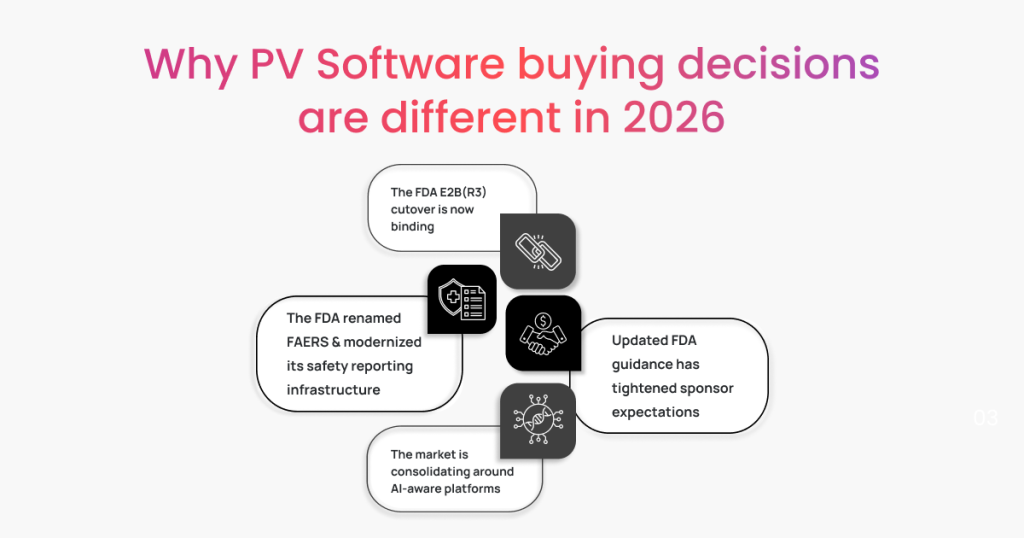
1. The FDA E2B(R3) cutover is now binding
The FDA established a transition window from January 16, 2024, through April 1, 2026, for adopting ICH E2B(R3) for ICSR submissions. After April 1, 2026, submissions that are not E2B(R3) compliant will be rejected at the gateway with a negative acknowledgement. Any platform that cannot generate FDA-compliant E2B(R3) messages, with the regional data elements the FDA requires, is no longer fit for the US market.
2. The FDA renamed FAERS and modernized its safety reporting infrastructure
On March 11, 2026, the FDA migrated FAERS data into its new Adverse Event Monitoring System (AEMS), a unified platform built around standardized reporting protocols, AI-based redaction tools, and broader cross-product surveillance.Buying decisions made in 2026 should anticipate that downstream regulator infrastructure is also evolving, and PV vendors who treat the gateway layer as static will fall behind.
3. Updated FDA guidance has tightened sponsor expectations
In December 2025, the FDA issued two final guidance documents covering investigator and sponsor safety reporting responsibilities for IND, IDE, and BA/BE studies. The sponsor guidance reaffirmed the 15-calendar-day window for expedited IND safety reports and the 7-calendar-day window for unexpected fatal or life-threatening suspected adverse reactions, and replaced the earlier 2012 sponsor guidance entirely. Workflow rules built into the safety database, not manual oversight, are how teams meet these timelines consistently.
4. The market is consolidating around AI-aware platforms
Adverse event volumes and intake breadth have moved past what manual workflows can consistently absorb. ICSRs now arrive through call centers, email, web portals, social channels, and literature surveillance, much of it unstructured. To add to that, the 7- and 15-day regulatory clocks remain fixed, forcing a shift in how platforms are evaluated.
Buying committees no longer view AI as a “nice-to-have” differentiator; they now treat it as a requirement. Evaluation has shifted from asking if AI exists to auditing its governance, inspection readiness, and “human-in-the-loop” validation. Vendors lacking robust controls are being disqualified early in the RFP process.
Core Capabilities to Prioritize in a Modern PV Platform
Vendor demos rarely fail in the same way as buyers’ production environments fail. The features that look impressive on a demo screen are not always the features that hold up under regulatory inspection or peak case volumes. The following capabilities consistently distinguish functional platforms from those that create downstream risk.
ICSR processing and MedDRA coding
The platform must support consistent MedDRA coding at the Lowest Level Term (LLT) using the LLT MedDRA numeric code, in line with FDA technical specifications for E2B(R3).Look for:
- Built-in MedDRA coding suggestions with confidence scoring and reviewer override.
- WHODrug integration for substance and product coding.
- Soft validations and E2B validations that catch incomplete fields before submission, not after gateway rejection.
- Configurable workflows that route serious cases for medical review faster than non-serious cases, with escalation triggers tied to expedited reporting timelines.
Multi-region E2B(R3) compliance and gateway connectivity
A platform that handles ICH E2B(R3) for one region is not the same as a platform that handles it for FDA, EMA, PMDA, MHRA, Health Canada, and other authorities concurrently. The data elements are harmonized. The regional implementation rules and gateway business logic are not. The buyer’s question is whether the platform manages all of these in a single configuration or whether each region requires a custom integration. Direct gateway integrations to ESG, EudraVigilance, and PMDA, with automatic acknowledgement handling and submission tracking, should be considered a baseline, not a premium feature.
Adverse event reporting software and intake breadth
Adverse event reporting software is the largest functional segment of the PV software market by revenue, accounting for roughly 38.50% of segment share in 2025.Modern intake is multi-channel by default. Evaluate whether the platform captures cases from
- Medical Information Call Centers (MICC) with telephony integration.
- Email channels with structured parsing.
- Web portals for consumer and healthcare professional submissions.
- Structured forms (CIOMS, MedWatch, SAE) from affiliates and partners.
- Literature surveillance pipelines.
AI-powered case intake (where GenAI genuinely belongs)
This is one of the few areas where Generative AI has a defensible operational role today. GenAI-enabled case intake reads unstructured source documents (emails, scanned forms, narrative PDFs, call transcripts), extracts ICSR-relevant fields, and pre-populates the case form for human reviewer validation.
The benefits are concrete: less transcription, fewer downstream coding inconsistencies, and cleaner data entering the safety workflow.
The non-negotiables are equally specific: reviewer-in-the-loop confirmation, audit trails of every AI-assisted field, and guardrails against fabricated content.
Buyers should ask vendors how they handle hallucination risk, what their semantic verification approach is, and how they document AI-assisted vs human-validated decisions.
Signal detection (automation-led, statistically grounded)
AI-powered signal detection is one of the most discussed capabilities in PV software demos. The honest answer is that signal detection in production is automation, applied to validated statistical methods. The methods that matter are well-defined: Proportional Reporting Ratio (PRR), Reporting Odds Ratio (ROR), Bayesian methods such as EB05 and EBGM, and chi-square-based analyses.
Modern signal management platforms add automation around threshold mapping, integration with multiple ICSR sources (FAERS/AEMS, EudraVigilance, WHO VigiBase, internal databases), and workflow tracking from detection through validation and assessment. Machine learning does not replace the underlying disproportionality analysis; rather, it helps in noise reduction, prioritization, and pattern recognition across data sources.
This distinction matters during evaluation. Ask the vendor which calculations their system performs, against which datasets, and how the outputs are validated.
Literature monitoring (where GenAI delivers measurable value)
Literature surveillance is the second domain where GenAI has moved past pilot and into production. AI-driven literature platforms search PubMed, EMBASE, and regional databases through API integrations, classify articles by ICSR relevance, detect cross-publication duplicates, and extract case-level data for direct E2B(R3) ingestion into the safety database.
The buyer’s evaluation should focus on three things: how the system distinguishes a pharmacokinetic study that mentions a drug from a case report containing a reportable adverse event; how it handles duplicate detection across formats (conference abstract, full paper, cited review); and whether the literature platform is genuinely integrated with the safety database, or whether the handoff is still manual.
Audit trails and compliance architecture
Every action in a PV database must be traceable to a user, a timestamp, and a record version, in line with 21 CFR Part 11 and EU GMP Annex 11. The compliance question is not whether the platform claims to be Part 11 compliant. It is whether the audit trail is computer-generated, tamper-evident, and inspection-retrievable on demand.
Test this in evaluation. Ask the vendor to retrieve the full lifecycle of a sample case, including every status change, signature, and submission action. If it requires multiple systems and manual reconciliation, you have your answer.
AI vs Automation in PV Software: Cutting Through the Marketing
“AI-powered” appears in nearly every PV software vendor’s marketing copy. The capabilities behind that label vary enormously. The buyer’s job is to identify what is genuinely AI-driven, what is rule-based automation, and where each one belongs.
| Capability | What It Realistically Is in Production | Buyer’s Verification Question |
|---|---|---|
| Case intake from unstructured sources | GenAI / LLM-driven extraction with reviewer validation | How are AI-extracted fields differentiated from human-validated fields in the audit trail? |
| Literature screening and ICSR identification | NLP-driven classification, GenAI-enabled extraction | What is the system’s specificity rate, and how is it independently validated? |
| MedDRA coding suggestions | NLP-based suggestion engine with confidence scoring | What confidence threshold triggers mandatory human review? |
| Duplicate case detection | Probabilistic matching and rules-based validation | What fields drive the matching logic? Can thresholds be configured? |
| Signal detection | Automation around PRR, ROR, EBGM, and similar statistical methods | Which datasets are screened? How is the output documented for inspection? |
| Regulatory submission | Rules-based automation with E2B(R3) validation | Are validation errors caught before the gateway, or only after rejection? |
| Aggregate reporting (PSUR, DSUR) | Template-driven automation with controlled vocabularies | Where does AI assist (drafting, summarization), and where does human review remain mandatory? |
Reliability is the second test. AI signal detection in PV software is reliable when it is anchored to validated statistical methods, run against complete datasets, and produces explainable outputs. It is unreliable when the system markets pattern recognition as prediction without showing how it would defend the output during an inspection.
Both regulators and quality teams have moved toward the same expectation: every AI-assisted decision must be reconstructable, with the data that went in, the model version that processed it, and the human oversight that validated the output. Platforms designed to that standard are the real deal.
Cloud vs On-Premise: Resolving the Deployment Question
The cloud vs on-premise debate has shifted. Where the conversation was once dominated by data residency and IT control concerns, modern enterprise pharmacovigilance buyers now treat compliance posture, validation effort, and total cost as the primary considerations.
According to Precedence Research, the on-premise segment held the largest delivery mode share at 46.50% in 2024, while cloud-based PV software is projected to grow at the fastest CAGR through 2035.
The data tells a clear story: large enterprise buyers retain on-premise deployments for legacy reasons, while net-new buying is moving to the cloud.
Cloud-based PV databases
- Faster deployment Validated cloud environments shorten the lead time between contract and go-live
- Predictable patching and validation Vendor-managed updates reduce the internal IT and QA burden, provided the vendor uses configurable, validated workflows rather than hard-coded customization.
- Audit-ready architecture by default Encryption at rest and in transit, identity management, and tamper-evident audit trails are standard, not custom configurations.
- Compliance posture A properly architected cloud PV database meets 21 CFR Part 11, Annex 11, GxP, HIPAA, and GDPR requirements without compromise. The vendor's data residency, certifications (ISO 9001, ISO 27001), and breach notification practices are the relevant evaluation criteria.
On-premise PV databases
- Full data residency control Useful for organizations with country-specific legal mandates that prevent cloud hosting.
- Larger upfront investment Server infrastructure, validation, and ongoing maintenance shift onto the buyer's IT and QA teams.
- Slower change cycles Workflow updates, version upgrades, and security patches require internal coordination, often with full revalidation cycles attached.
For most pharma, biotech, and CRO buyers in 2026, cloud-based PV software is the operational default unless a specific regulatory or contractual constraint requires on-premise. The decision criterion is not the deployment model itself. It is whether the vendor can demonstrate audit-ready compliance, predictable cost, and a configuration model that does not break with every change.
Implementation Timeline: What Realistic Looks Like
The honest answer to “How long does it take to implement a PV database from scratch?” is: it depends on whether you are building from zero, or migrating from an existing system, and on the complexity of your case data.
According to ICON’s analysis published in European Pharmaceutical Review, E2B and E2B-hybrid migration approaches typically take four to six months to complete, while technical migrations involving complex business rules and large case volumes often run five to nine months. These ranges are baseline expectations, not stretch targets.
What drives the timeline
- Migration approach Manual re-entry is slow but predictable. E2B-based migration is faster but requires clean source data. Technical migration is faster still but demands specialist resources and validation effort.
- Number of integrations Each gateway, third-party safety system, electronic data capture (EDC) platform, and regulatory portal integration adds time. A phased rollout is often more compliant than a single big-bang go-live.
- Validation scope Configurable platforms limit revalidation to what changed, while heavily customized platforms often require full system revalidation after every update.
- User training and SOP alignment Workflow configuration must match approved SOPs, and SOPs sometimes need updating to match what the system enforces. This is an operational change, not technical work.
Implementation pain points to consider
The most common drug safety software integration pain points reported across pharma and CRO teams cluster in five areas: legacy data quality (data that the new system rejects), gateway certification cycles for FDA and EMA, MedDRA version alignment between source and target, custom field mapping that did not exist in the source system, and parallel-run workload during the validation period. These hurdles are manageable, yet they remain the primary cause of missed go-live dates when overlooked. Early identification during discovery is the only way to protect the implementation schedule.
Total Cost of Ownership Over 3 to 5 Years
The license fee is rarely where the real cost lives. A defensible PV software TCO model accounts for the full set of cost categories across a 3 to 5-year horizon.
| Cost Category | What It Includes | Typical Share of TCO |
|---|---|---|
| Software licensing | Subscription or perpetual licenses, user tier costs, module-level licensing | Lowest in cloud; higher and front-loaded in on-premise |
| Implementation and configuration | Workflow setup, role configuration, MedDRA and WHODrug setup, gateway certification | Significant, especially in year one |
| Data migration | Source extraction, validation, transformation, target loading, parallel-run support | Material for organizations with legacy case volumes above ~5,000 cases |
| Validation and qualification | IQ/OQ/PQ documentation, change control, ongoing revalidation | Often underestimated, recurring |
| Integrations | EDC, CTMS, QMS, third-party safety systems, partner exchange | Recurring as integrations evolve |
| Training and change management | Initial training, refresher cycles, and role-specific certification | Recurring annually |
| Support and maintenance | Vendor support fees, internal helpdesk, SLA escalations | Recurring |
| Infrastructure | Hosting, security tooling, disaster recovery (on-premise only) | Concentrated on on-premise deployments |
The categories that buyers most often overlook are validation effort over time and integration maintenance. A platform that is cheap to license but requires a full revalidation cycle for every workflow change is rarely cheaper over five years. The most cost-effective platforms in the long run are configurable, validated cloud systems where workflow updates are made through controlled settings rather than custom code.
PV Software for CROs: A Different Set of Demands
Contract Research Organizations (CROs) running pharmacovigilance services for multiple sponsors operate the safety database under different rules than a single-sponsor pharma company. The platform must support multi-tenant data segregation, sponsor-specific configurations, and submission to different regulatory environments, often under different SLAs.
For CROs, the evaluation criteria expand:
- Multi-tenant architecture Each sponsor's data must be logically segregated, with role-based access that prevents cross-client visibility.
- Sponsor-specific workflow configuration Two sponsors can require different escalation rules, narrative templates, or submission profiles within the same platform instance.
- Reporting flexibility Each sponsor will want their own dashboards, KPIs, and audit-ready reports.
- Onboarding speed CRO economics depend on the time it takes to bring a new sponsor live. Platforms that require weeks of custom development per sponsor are not viable at scale.
- Service level monitoring Built-in SLA tracking against sponsor obligations is essential.
The pharmacovigilance market overall is shifting in this direction. CRO-grade PV platforms are no longer a niche. They are core to how mid-market and emerging biotech sponsors deliver compliant safety operations without building internal infrastructure.
Building a Vendor Shortlist: A Practical Evaluation Framework
A defensible PV software shortlist starts with clarity on the problem the platform is being bought to solve, not a feature list pulled from analyst grids. The framework below is structured around the questions that should drive procurement.
Step 1. Define the operational baseline
- Annual case volume, expected growth, and case complexity.
- Number of products, indications, and geographies covered.
- Required regulatory submissions (FDA, EMA, PMDA, MHRA, Health Canada, others).
- Existing systems and integrations (EDC, CTMS, QMS, MICC).
- Internal vs outsourced safety operations split.
Step 2. Define non-negotiables
- ICH E2B(R3) compliance with FDA-specific regional data elements before April 1, 2026.
- 21 CFR Part 11 and Annex 11 validated audit trails.
- Multi-region gateway connectivity.
- MedDRA and WHODrug coding integration.
- Configurable workflows that match approved SOPs without custom development.
Step 3. Define differentiators
- GenAI-enabled case intake and literature surveillance with reviewer-in-the-loop controls.
- Automated signal detection across multiple ICSR sources.
- Real-time SLA tracking and submission monitoring dashboards.
- Integration with adjacent quality and clinical platforms.
- Implementation methodology, including data migration approach and validation framework.
Step 4. Validate with operational testing
- Run a sandbox test using a representative sample of your case data, including complex narratives.
- Test the audit trail by retrieving the full lifecycle of a sample ICSR.
- Test gateway submission against test environments (FDA ESG staging, EMA XCOMP).
- Test the system's behavior at peak volume, not just at the demo volume.
- Speak with two reference customers in your size band, ideally with a similar geographic scope.
Step 5. Pressure-test the contract
- Service Level Agreements for system availability, gateway uptime, and incident response.
- Validation responsibility is split between the vendor and the customer.
- Vendor obligations during regulatory inspections.
- Change control for AI model updates and platform versions.
- Data portability commitments at exit.
Building a Vendor Shortlist: A Practical Evaluation Framework
Clinevo OnePV is a unified pharmacovigilance platform designed to address the operational and compliance demands described across this guide. It brings the four core PV functions, MICC and case intake, safety database, signal detection, and literature management, into a single integrated environment, with a deliberate architectural distinction between where AI belongs and where automation does.
Where Clinevo OnePV applies GenAI
- Clinevo Case Intake (with telephony via AWS Connect) GenAI extracts ICSR-relevant fields from unstructured emails, scanned forms, and call transcripts, with reviewer-in-the-loop validation, multi-language identification, and HIPAA and GDPR-compliant data handling.
- Clinevo Literature Automation Platform AI-driven literature surveillance integrates directly with PubMed and EMBASE through APIs, classifies articles into ICSR-relevant, PSUR/Signal-relevant, and invalid using a curated keyword library, performs cross-publication duplicate detection, and generates E2B R3 XML for direct ingestion into the safety database.
Where Clinevo OnePV applies validated automation
- Clinevo Safety Database Real-time data quality validation, automated E2B follow-up assessment, intelligent case routing, automated narrative generation aligned to E2B(R3), and gateway-integrated submission with auto-reporting rules. Compliance with 21 CFR Part 11 and Annex 11 is built into the architecture.
- Clinevo Signal Detection Automated disproportionality analysis using PRR, ROR, EB05, EBGM, and Chi-Square methods, with automated threshold mapping, therapeutic area-based stratification, and integration with FAERS/AEMS, EVDAS, WHO VigiBase, and internal data sources.
Why this matters for buyers
The platform is configurable rather than custom-coded, which limits the scope of revalidation when workflows change. It supports multi-region gateway submissions to the FDA, EMA, PMDA, and other authorities, ready for the April 1, 2026, FDA E2B(R3) cutover. It is compliant with USFDA, EMA, ICH, GxP, GAMP, HIPAA, GDPR, 21 CFR Part 11, and Annex 11 standards, and Clinevo Technologies is certified to ISO 9001 and ISO 27001. It is deployed across pharma, biotech, device, vaccine, and CRO clients in the USA, UK, Europe, and India.
Frequently Asked Questions
Realistic timelines depend on whether you are starting fresh or migrating from an existing safety database. For migration projects, ICON's published analysis indicates that E2B and E2B-hybrid migrations take approximately four to six months, while technical migrations of complex case data often run five to nine months. Greenfield implementations without legacy data can be faster, but validation, MedDRA setup, integration testing, and gateway certification still typically place the realistic range between three and six months. Configurable cloud platforms compress this timeline depending on legacy customized deployments.
The most consistent integration pain points are: legacy data quality issues that surface only during migration, MedDRA version mismatches between source and target systems, custom field mappings that do not exist in standard E2B schemas, gateway certification cycles for FDA ESG and EudraVigilance that take longer than vendors' initial scope, and parallel-run periods that strain the safety team's capacity. The avoidable ones are addressed during discovery, while the unavoidable ones can be tackled by adopting a realistic timeline and validation planning.
Yes, but the quality of multi-region support varies significantly. The ICH E2B(R3) standard harmonizes the data structure, but each authority applies different regional data elements and gateway business rules. The FDA's regional implementation guide for E2B(R3) requires US-specific elements; EMA submissions go through the EudraVigilance Gateway with EU-specific validation; PMDA uses its own gateway with Japanese reporting requirements. A modern PV platform should manage all of these from a single configuration with direct gateway integrations and automated acknowledgement handling. Anything less is an integration project, not a global PV solution.
Look for native MedDRA integration with coding suggestions at the LLT level, WHODrug for product coding, soft validations, and full E2B validations that catch field-level issues before submission, configurable case routing based on seriousness and jurisdiction, automated duplicate detection using probabilistic matching, and an audit trail that captures every coding decision and override. Confidence scoring on AI-suggested codes, with reviewer override, is now a baseline expectation rather than a differentiator.
In production, signal detection is automation built around validated statistical methods (PRR, ROR, EB05, EBGM, Chi-Square), applied to ICSR data from sources such as FAERS/AEMS, EudraVigilance, WHO VigiBase, and internal safety databases. Machine learning adds value in noise reduction, prioritization, therapeutic area stratification, and pattern recognition across data sources. It does not replace the underlying disproportionality analysis. Signal detection is reliable when the methods are validated, the data sources are complete, the outputs are explainable to regulators, and human medical judgment governs the final assessment. AI claims that bypass these foundations are not reliable in a regulatory context.
TCO varies widely with case volume, geographic scope, and deployment model. The cost categories that drive most enterprise PV software TCO across a three to five-year horizon are software licensing, implementation and configuration, data migration, validation and qualification, integrations, training, vendor support, and infrastructure (for on-premise). License fees are usually a minority of the total. Validation effort over time and integration maintenance are the categories most often underestimated. Configurable cloud platforms generally produce lower TCO than heavily customized on-premise deployments, primarily because validation scope stays bounded to what changed, rather than the entire system.
Yes, when properly architected. A cloud-based PV database can fully meet 21 CFR Part 11, Annex 11, GxP, HIPAA, and GDPR requirements with encryption at rest and in transit, identity-based access control, tamper-evident audit trails, and certified data centers. The relevant evaluation criteria are the vendor's data residency commitments, security certifications (such as ISO 27001), breach notification practices, validation framework, and SLA-backed availability commitments. Cloud is no longer the compliance compromise it was a decade ago. For most new PV software buyers, cloud is the operational default.
CROs need a multi-tenant pharmacovigilance platform with strict data segregation, sponsor-specific workflow configuration, role-based access that prevents cross-client visibility, sponsor-level reporting and SLA tracking, and fast onboarding. The platform should also support different regulatory submission profiles per sponsor without custom development. Clinevo OnePV is built with this multi-sponsor scenario in mind, with configurable workflows per client, integrated MICC, literature, and signal management, and direct gateway connectivity for FDA, EMA, and other authorities. Buyers evaluating PV software platforms for CRO use cases should specifically validate multi-tenant architecture, onboarding speed, and SLA tooling.
Choosing a PV Software Partner That Holds Up Under Inspection
Pharmacovigilance software is one of the most consequential platform decisions a regulated life sciences organization will make. The wrong choice surfaces during audits, missed expedited timelines, and gateway rejections. The right choice produces a system of record that protects patient safety and regulatory standing across the product lifecycle.
Clinevo OnePV is designed to be that system. If you are evaluating drug safety platforms in 2026, book a tailored walkthrough with the Clinevo team or submit an RFP aligned to your specific regulatory and operational scope.