





The first task of a Monday morning for many pharmacovigilance literature teams looks the same week after week: opening a review queue that has accumulated new articles across the weekend. Before any medical review begins, a reviewer must determine which articles contain safety-relevant information, which are duplicates of records already processed, which are pharmacokinetic studies or in-vitro research that mention a drug only in passing, and which contain a genuine adverse event report that may need to become an Individual Case Safety Report (ICSR).
That determination, performed manually, is where a significant portion of the pharmacovigilance team’s effort disappears each week. It is also the portion where AI can deliver the greatest operational value in literature review automation.
The efficiency case for AI-assisted literature screening in pharmacovigilance is well supported by research. A synthesis published in Frontiers in Pharmacology in January 2025, drawing on multiple structured literature review automation studies, found that AI-assisted screening tools can reduce the volume of articles requiring human review to as low as 23% of the total retrieved, with time savings per review cycle ranging from 7 to 86 hours. While this isn’t exactly a theoretical reduction, it changes what pharmacovigilance professionals are doing each week and determines whether recovered hours are allocated to high-value medical analysis or returned to the same manual queue.
This article explores where those efficiency gains actually come from, how they can create more capacity for high-value clinical assessment, and what it takes to implement AI-based literature review capabilities in a way that is technically sound, operationally reliable, and ready for regulatory scrutiny.
The Regulatory Requirement Behind a Growing Workload
The obligation for systematic literature surveillance in pharmacovigilance is not discretionary. The EMA’s Good Pharmacovigilance Practices (GVP) Module VI requires Marketing Authorization Holders to conduct structured monitoring of the medical literature at a minimum weekly frequency, with complete documentation of search strategies, article-level screening decisions, and the rationale for any exclusions.
That weekly cadence applies to every indexed database relevant to a product’s therapeutic area. For organizations with broad or growing portfolios, the number of search-database combinations running simultaneously can be substantial. Each search cycle produces a fresh results set. Each results set requires evaluation before the next cycle begins.
The FDA’s corresponding expectations for post-marketing literature surveillance are consistent with this structure. Organizations operating across multiple jurisdictions are not managing parallel processes with different standards. They are running the same surveillance requirement simultaneously in multiple regulatory contexts, each with its own documentation expectations.
50
New molecular entities cleared by the FDA in 2024. Each approval extends a post-marketing surveillance obligation that the sponsoring organization must maintain indefinitely — expanding workloads without automatic increases in team capacity.
In scenarios of ever-increasing literature database and review workload, AI can help PV teams absorb growing literature screening demand more effectively while preserving review quality and consistency.
What the Manual Screening Burden Actually Looks Like
Understanding where this scale of efficiency gain comes from requires a clear picture of what manual literature screening involves at each stage. The workload is not uniform. Some stages are rules-based and repetitive. Others require medical judgment that cannot and should not be automated. Conflating the two produces both overestimates of what AI can do and underestimates of where its value actually lies.
A standard manual pharmacovigilance literature screening workflow involves four distinct steps:
| Stage | What It Involves | Where AI Adds Value |
|---|---|---|
| Title & Abstract Screening | Evaluating whether an article could contain safety-relevant information. The majority of retrieved articles do not pass this stage. | Very high. High-volume relevance assessment, exclusion logic, and pattern recognition make this the most suitable stage for AI support. |
| Full-Text ICSR Review | Determining whether an article contains a specific, attributable, reportable individual case — not just aggregate adverse event mentions. | Limited. AI can support prioritization and pre-qualification, but final determination requires a qualified expert’s review. |
| Duplicate Detection | Identifying when the same case has been published across multiple formats: abstract, journal article, and cited case in a subsequent review. | High for identifying narrative similarity and publication overlap; human review remains essential for borderline cases. |
| Data Extraction & ICSR Creation | Structuring demographics, event details, drug exposure data, & source documentation for safety database entry. | High for extracting and structuring fields, though final case approval must remain with authorized human reviewers. |
The line between what AI handles and what qualified reviewers validate is the structural distinction that makes AI-enabled literature screening both efficient and inspection-ready. That distinction must be explicit in system documentation, SOPs, and the audit trail itself.
What is Inside the Literature Queue — and Where the Hours Go
The efficiency argument for AI-assisted pharmacovigilance screening rests on a well-established pattern in medical literature research: the proportion of irrelevant articles in a typical search results set is large, and the criteria for excluding them are substantially consistent and learnable by machine learning systems.
A 2024 study published in Educational Psychology Review, evaluating machine learning screening algorithms across multiple systematic review datasets, found an average 58% reduction in the screening workload of irrelevant records when learning algorithms were applied to abstract screening. In health sciences applications, the same analysis cited evidence that learning algorithms can reduce the time required for manual abstract screening by more than 90% in some implementations
In pharmacovigilance specifically, this pattern applies directly to the title and abstract screening stage. The large majority of articles retrieved in a typical PV literature search do not contain adverse event content relevant to the product under surveillance. They include general pharmacology reviews, disease epidemiology studies, in-vitro investigations, and articles where the product appears only as a comparator arm.
What makes AI-assisted literature review reliable in a pharmacovigilance context is not general language capability but domain-specific precision. General-purpose models do not perform well on PV-specific screening tasks without fine-tuning. The difference between a pharmacokinetic study that references an adverse event in a footnote and a case report that contains a specific, attributable, reportable individual reaction is not something broad keyword matching can identify reliably. Systems trained on pharmacovigilance relevance criteria, with curated term libraries covering adverse event descriptions, MedDRA-coded reactions, and causality language, make this distinction consistently and at scale.
Where the Recovered Time Goes in PV Teams
This question directly addresses why AI-powered literature review matters beyond operational efficiency.
If a pharmacovigilance team is not spending the majority of its hours on manual screening, what does it do instead? The answer has material implications for drug safety outcomes.
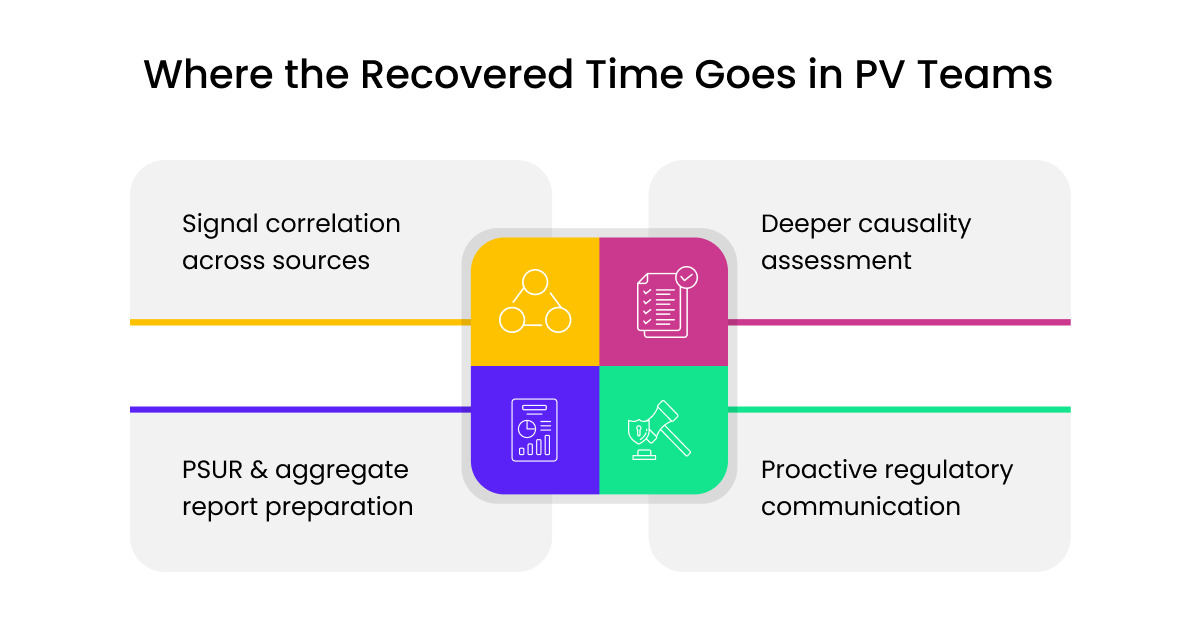
AI literature automation does not reduce the amount of pharmacovigilance expertise an organization needs. Rather, it changes where that expertise is applied, shifting it from high-volume, low-judgment screening to the analytical and clinical work that constitutes the actual purpose of a pharmacovigilance operation.
The Technical Requirements for Audit-Ready Literature Screening Automation
Organizations evaluating AI-assisted literature review consistently raise a version of the same question: how does an AI-based screening system document its decisions in a format that holds up under regulatory inspection? The answer depends entirely on how the automation is implemented. Three technical requirements must be met.
Search execution and result logging must be fully auditable. Every database queried, every search string used, every result set retrieved, and the timestamp of each execution must be logged in a format that can reconstruct the complete search history on demand. GVP Module VI requires documentation of search strategies. A system that produces this documentation as part of its normal operations satisfies that requirement without retrospective assembly. API-based direct integration with indexed literature sources supports this natively.
Screening decisions must be attributable and preserved at the article level. For each article in the results set, the system must record whether it was excluded by AI-supported triage or by human review, which criteria applied, and in cases involving human review, which qualified reviewer made the determination. Under 21 CFR Part 11 and EU GMP Annex 11, electronic records and audit trails must be computer-generated, tamper-evident, and time-stamped.
The boundary between AI-enabled pharmacovigilance screening and human validation must be explicit, documented, and enforced by the system. AI-supported triage of title and abstract relevance is a documented, rules-based operation with defined exclusion logic. Final determination of ICSR validity, causality assessment, and data entry into the safety database require qualified human review and documented approval. These two stages must be clearly delineated in SOPs, system documentation, and the audit trail itself.
Clinevo's Literature Automation Platform: Purpose-Built for PV Surveillance
Clinevo’s Literature Automation Platform is designed specifically for the pharmacovigilance literature surveillance workflow, not adapted from academic reference management tools or general scientific literature systems. Each capability below addresses a discrete failure point in manual surveillance operations.
| Search & Retrieval Direct API integration with PubMed & EMBASE |
The platform connects to PubMed and EMBASE through direct API integrations, enabling scheduled, AI-enabled literature workflows with full logging of query settings, timestamps, and response records. GVP Module V-compliant documentation is produced as a standard operational output — users no longer need to reconstruct search histories from downloaded logs or email threads. Every search is auditable from execution to result set. |
| AI Triage NLP Classification with 2.5M+ Keyword Library |
The NLP classification layer is trained on pharmacovigilance-specific terminology, drawing on a curated library exceeding 2.5 million keywords. This enables the system to distinguish between articles that mention a drug and those that contain relevant adverse event information. Clinical relevance criteria — definitions that broad keyword matching cannot make reliably. Noise removal operates at the title and abstract level, filtering pharmaceutical studies, in-vitro research, and off-label content before they reach the human review queue. Reviewers can then focus their attention on articles that have already been screened for pharmacovigilance relevance, reducing time in the review and making manual review more efficient. |
| Duplicate Detection | The duplicate detection layer goes beyond DOI matching. It identifies situations where the same patient case has appeared across multiple publications, conference abstracts, and follow-up journal articles. |
| Narrative-Level Cross-Publication Matching |
conference abstract, a full journal article, and a cited case in a subsequent systematic review — even when authors, journals, and DOIs all differ across publications. High-confidence matches are confirmed and consolidated by the system and logged in the audit trail. Cases where confidence is moderate are presented side by side for reviewer determination, keeping human judgment in place for ambiguous situations. |
| Classification Three-Category Literature Routing |
Screened literature is categorized into three structured classifications: ICSRs-relevant, PSUR and Signal-relevant, and invalid. This supports cross-program and aggregate reporting simultaneously. Articles containing non-ICSR safety information relevant to periodic reporting are retained and routed appropriately, rather than excluded from the workflow entirely. |
| Case Transfer Automated E2B R3 XML Generation |
For validated ICSRs, the platform generates E2B R3-compliant XML outputs, mapping all essential fields (demographics, adverse event terms, drug details, causality indicators, and source documentation), against the ICH E2B(R3) schema. This eliminates manual transcription from article to safety database and produces a regulatory gateway. |
| Compliance 21 CFR Part 11, Annex 11, GxP & GDPR |
Compliance requirements are embedded in the system architecture, not layered on after the fact. Audit trails are generated as a standard operational output, covering the full pathway from search execution through triage decision, human validation, and case submission. The platform integrates in-built with Argus Safety, ArisGlobal, and Clinivo Safety, with browser-based access supporting global team collaboration across time zones. |
Frequently Asked Questions
AI handles the title and abstract triage stage — assessing each retrieved article for PV relevance before it reaches a human reviewer. It also automates duplicate detection across publications and, for confirmed ICSRs, the mapping of extracted data into E2B R3-compliant format. Final ICSR validation and causality assessment remain with qualified human reviewers.
Into work that requires clinical judgment: causality assessment, cross-referencing literature findings against spontaneous case data, PSUR evidence preparation, and proactive regulatory communication. Automation shifts what staff spend their time on — not whether their expertise is needed.
Three things: that every search is fully reconstructable with timestamps and search strings; that each article-level screening decision is attributed and preserved; and that the system enforces a clear boundary between automated triage and human validation. Documentation assembled after the fact does not satisfy this — it needs to be generated in real time as part of normal operations.
Through narrative-level analysis, not just DOI matching. The system can identify the same patient case across a conference abstract, a journal article, and a cited case in a review — even when authors, journal names, and DOIs all differ. High-confidence matches are merged automatically; borderline cases are presented side by side for human review.
Yes. It connects via API to Argus Safety, ArisGlobal, and Clinevo Safety, and can run in parallel with existing processes during the validation period. ICSR transfer only begins once validation is complete, so ongoing surveillance and submission timelines are unaffected.