




Every pharmaceutical and medical device company operating in a regulated environment runs a quality management system. The FDA finalized the Quality Management System Regulation (QMSR) in February 2024, aligning 21 CFR Part 820 with ISO 13485:2016, with a compliance deadline of February 2026.
Yet, in FDA fiscal year 2025, 38 out of 44 Warning Letters issued to medical device manufacturers cited Quality System Regulation violations under 21 CFR 820. Corrective and Preventive Action (CAPA) deficiencies topped the list for the first time, appearing in 26 of those letters.
These were not companies without quality systems. They were companies whose quality systems could not keep up with the demands placed on them.
This is exactly the problem that QMS automation in regulated environments is built to solve. Manual quality management processes work on a small scale. However, as organizations grow and product portfolios expand, spreadsheets and paper-based sign-offs start to create gaps. Corrective and Preventive Action investigations get closed without confirmed root causes. Change requests sit unreviewed for weeks. Training records cannot be produced when an auditor asks for them.
These gaps do not appear all at once. They build up over time, and an inspection is usually what brings them to the surface.
This blog aims to help understand why QMS automation is essential at scale, what to prioritise first, and how a purpose-built eQMS can reduce audit risk while making quality operations easier to manage and maintain.
When Manual QMS Processes Start to Break Down
Most manual quality systems are not poorly designed. They are designed for a specific stage of a company’s growth and are never updated when that stage passes. The result is a system that looks compliant on paper but cannot enforce consistency at scale.
What makes this particularly costly in regulated environments is that the failures are not immediately visible. They compound quietly across processes until an inspection brings them to the surface. The most common failure patterns are:
- Audit findings from one site are never visible to teams at another site, so the same issue recurs across locations without anyone connecting the pattern.
- A change request is approved informally over email, leaving no verifiable audit trail when an inspector asks for it.
- A training gap goes undetected because a revised Standard Operating Procedure (SOP) was never formally assigned to the right people.
- Audit evidence is scattered across shared drives and paper files, making it difficult to compile quickly and accurately under inspection conditions.
These failures share a common thread: the system allowed them to happen. And reducing manual quality processes and errors in regulated environments is not just an efficiency goal — it is a compliance requirement.
What to Automate First in an eQMS?
When an organisation decides to move from paper or spreadsheet-based quality management to a scalable electronic quality management system, the question of where to begin matters. Implementing automation across every process at once is rarely practical. The more effective approach is to prioritise the areas that generate the greatest compliance risk when left on manual processes.
Based on FDA enforcement patterns and industry experience, three areas consistently deliver the highest impact when automated early. The table below outlines what automation solves in each area and why it matters from a compliance perspective.
| QMS Process | What Automation Solves | Compliance Impact |
|---|---|---|
| CAPA Management | Automated routing, escalation triggers, deadline tracking, and effectiveness check reminders replace manual follow-up. Root cause steps are structured and cannot be bypassed. | Directly addresses the leading cause of FDA Warning Letters in FY2025. Closed-loop CAPA with documented evidence replaces paper trails that fall apart under inspection. |
| Change Control | Workflow automation routes change requests to the right reviewers in the correct sequence, with electronic approvals and timestamps at every stage. Nothing sits in an inbox untracked. | Eliminates approval delays that create compliance gaps. Every decision is documented, time-stamped, and retrievable for audit. |
| Training Management | Training tasks are assigned automatically based on role, SOP version, or product scope changes. Completion tracking and gap reporting happen in real time, without manual spreadsheet updates. | Training records are among the most commonly cited documentation failures in FDA inspections. Automated systems ensure records are complete, current, and inspection-ready at all times. |
Validating Automated Workflows Without Creating a Maintenance Problem
A common concern among quality teams evaluating an eQMS is what happens after the QMS go-live. The fear is that a validated system becomes a maintenance burden every time a quality process needs to change. This is a legitimate concern with older, heavily customised platforms where even minor updates require IT involvement and can trigger full revalidation cycles.
A configurable eQMS solves this differently. Instead of hard-coded logic that breaks with every change, process adjustments are made through controlled system settings. This means:
- Routing rules can be updated without IT involvement or code changes.
- Approval sequences can be modified to reflect organisational changes while remaining within the validated state.
- Escalation triggers and deadlines can be reconfigured as SOPs evolve, with each change automatically captured through documented change control within the platform.
Because the validation scope applies only to what changed rather than the full system, updates are faster and significantly less resource-intensive to manage over time.
Beyond maintainability, a well-designed eQMS also meets the data integrity requirements that regulators expect as a baseline. Under FDA 21 CFR Part 11 and EU Annex 11, audit-ready electronic quality records and traceability require every record to be attributable, legible, contemporaneous, original, and accurate.
In a well-configured eQMS, these requirements are enforced by the system automatically:
- Approval timestamps are generated by the platform, not entered manually.
- Electronic signatures are tied to verified user credentials.
- Every workflow action is logged in a tamper-evident audit trail that inspectors can access directly.
The result is that automated quality management workflows built on a configurable, validated platform become easier to maintain as the organisation grows.
How OneQMS Addresses This
Not every eQMS handles the compliance, configurability, and scalability requirements of regulated life sciences environments equally. What sets purpose-built platforms apart is how deeply these requirements are embedded in the product architecture rather than bolted on through customisation.
OneQMS – developed by Astakenis, a spin-off of Clinevo Technologies – meets the end-to-end quality management needs of life sciences organizations in regulated environments.
Organizations working with OneQMS benefit from Clinevo’s established compliance infrastructure and global track record, combined with the agility and depth of a team built specifically around quality management.
OneQMS is a cloud-based eQMS for life sciences and medical devices that brings all core quality processes together in a single integrated platform. Compliance with 21 CFR Part 11, Annex 11, GxP, and ISO 13485 is built into the platform architecture from the ground up.
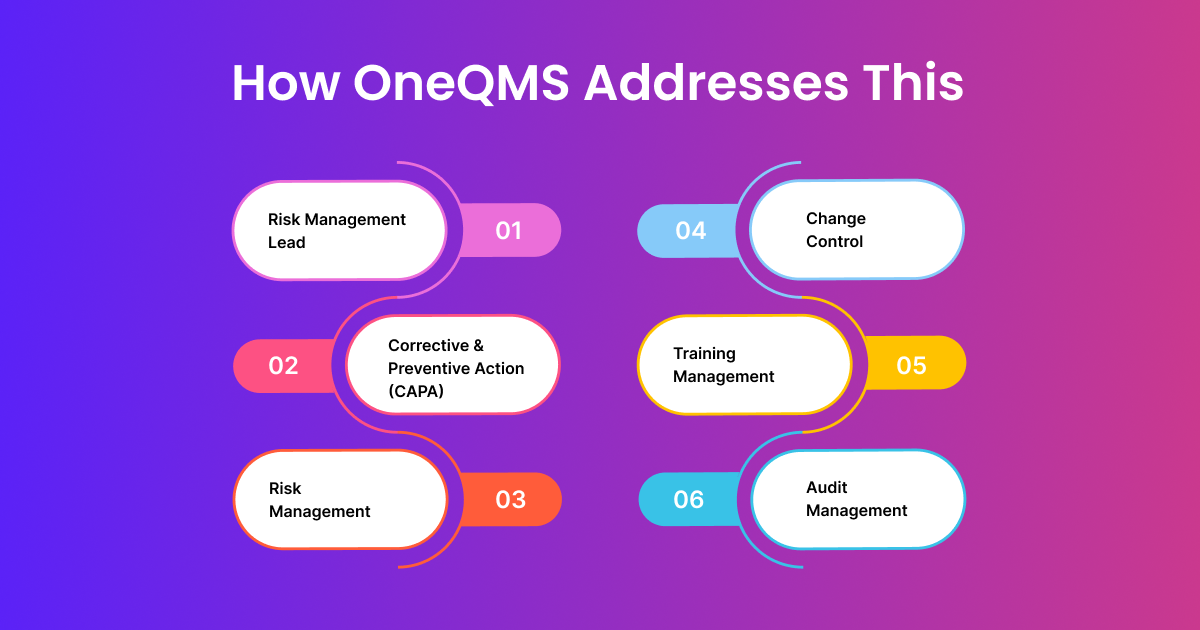
The key modules include:
-
Document Control - Centralised version management, electronic approval workflows, and controlled distribution with full audit trails. Every document revision is tracked, and every approval is time-stamped, so teams always work from the current approved version.
-
Corrective and Preventive Action (CAPA) - Structured investigation workflows that enforce root cause analysis, action planning, implementation, and effectiveness verification before a CAPA can be closed. No stage can be bypassed or skipped.
- Risk Management - Risk identification and assessment workflows that connect directly to CAPA, so that risks identified during reviews or audits flow automatically into corrective action without manual handoffs between systems.
- Change Control - Configurable routing that matches the organisation's review hierarchy, with parallel and sequential approval options, electronic sign-offs, and complete audit trails at every stage.
-
Training Management - Automated assignment of training tasks when SOPs are revised, roles change, or product scope is updated. Completion gaps are visible in real time and flagged before they become inspection findings.
- Audit Management - Structured audit planning, finding tracking, and response workflows that generate ready-to-retrieve records at any point in the audit cycle.
Building Quality Systems That Scale
Quality system expectations are not becoming more lenient. For organizations still running on manual processes, the gap between what the system produces and what regulators expect widens with every period of growth.
The good news is that closing this gap does not require a multi-year transformation. Reducing audit findings by using automated quality management systems starts with the right priorities. Most organizations that implement a modern eQMS see meaningful compliance improvements within their first operational cycle — typically within the first six to twelve months of deployment:
- Fewer overdue CAPAs with complete root cause documentation
- Faster change control closure with full electronic audit trails
- Up-to-date training records with no manual tracking required
- Audit evidence that can be retrieved on demand, not assembled under pressure
How to choose what to automate first in an eQMS for life sciences comes down to one question: where are manual processes creating the most compliance exposure right now? For most organizations operating under FDA and ISO 13485 requirements, the answer is Document Control, CAPA, Change Control, Training, and Risk Management. Addressing these areas within a validated, configurable platform gives quality teams the foundation they need to scale without accumulating audit risk — and to maintain inspection readiness as a continuous state, not an emergency exercise triggered by an upcoming audit.

Frequently Asked Questions
As product portfolios and site counts grow, manual quality processes cannot scale with them. CAPA tracking, change control routing, and training management all multiply in complexity with every new product and site. Automation handles the volume consistently, without the compliance gaps that manual systems accumulate at scale.
Incomplete documentation, missed deadlines, and audit trails that cannot be reconstructed under inspection. FDA FY2025 data shows that CAPA deficiencies are now the leading cause of Quality System Warning Letters for medical device manufacturers, which is a direct consequence of what manual quality systems cannot reliably produce.
They enforce required process steps, generate tamper-evident audit trails, and produce electronic records that meet 21 CFR Part 11 and Annex 11 requirements. Compliance becomes system-enforced and consistent rather than dependent on individual follow-through. A modern electronic quality management system also positions organizations well for the evolving regulatory landscape, including the QMSR transition underway for medical device manufacturers.
OneQMS uses configurable, validated workflows rather than hard-coded custom logic. Process changes are made through controlled system settings, each going through documented change control within the platform. This limits the scope of revalidation to the specific change rather than the full system.
While OneQMS is delivered by Astakenis, a spin-off of Clinevo Technologies, it is part of the broader Clinevo ecosystem, which spans pharmacovigilance, clinical trial management, and quality. Integration with Clinevo safety and clinical systems, as well as third-party platforms, is supported.