




Every six months, or annually depending on the product’s EU reference date (EURD) schedule, pharmacovigilance teams begin assembling one of the most resource-intensive documents in drug safety: the Periodic Benefit-Risk Evaluation Report (PBRER), or its regulatory counterpart, the Periodic Safety Update Report (PSUR).
The process typically starts at least two to four months before the submission deadline and involves medical writers, pharmacovigilance scientists, signal detection specialists, regulatory affairs teams, and clinical reviewers working simultaneously across disconnected systems.
The challenge is not the report itself. The challenge is everything that has to happen before the first section can be written. Signal data has to be extracted, verified, and reconciled. ICSR line listings have to be built. Cumulative case counts have to be validated against database outputs. And all of this has to be ready before the data lock point, with no room for error, because the submission window under EMA’s GVP Module VII is fixed.
This is where AI in pharmacovigilance aggregate reporting transforms from a forward-looking concept into an operational necessity. The real value of AI lies not just in drafting text, but in its ability to eliminate the massive ‘upstream’ burden of data preparation. By automating case reconciliation, validating line listings, and surfacing potential signals before the report even begins, intelligent systems allow teams to move beyond manual data-crunching. For organizations managing growing portfolios, the shift to automated safety reporting systems is no longer just about efficiency – it is about reclaiming the time needed for deep medical analysis and ensuring a flawless, audit-ready submission every time.
What Aggregate Safety Reporting Actually Involves
The PBRER, defined under ICH E2C(R2) and mandated in the EU through GVP Module VII, is not a summary of adverse events. It is a structured benefit-risk evaluation that draws on cumulative safety data, clinical trial findings, post-marketing experience, signal outcomes, and real-world evidence to determine whether a product’s risk profile has materially changed since the last reporting period.
The EMA and requires most PBRERs to be submitted within 70 days of the data lock point for reporting periods up to 12 months. For newer products, six-monthly cycles apply during the first two years post-authorization. Submission frequencies for subsequent periods are governed by the EURD list, which dictates the reporting cycle for each active substance from annual to as infrequently as every 16 years.
In practice, a single PBRER may contain upwards of 20 structured sections, including:
- A worldwide marketing authorization and regulatory action status
- Patient exposure estimates across indications and dosage forms
- Cumulative and interval case counts from spontaneous and clinical sources
- Signal detection summaries covering validated, closed, and ongoing signals
- An integrated benefit-risk evaluation with conclusions and proposed regulatory actions
Building each of these sections accurately, within a fixed timeline, and in alignment with other pharmacovigilance documents such as the Risk Management Plan and DSUR, is what makes aggregate reporting structurally demanding regardless of the team’s experience level.
50
New molecular entities cleared by the FDA in 2024. Each approval extends a post-marketing surveillance obligation that the sponsoring organization must maintain indefinitely — expanding workloads without automatic increases in team capacity.
Where Manual PBRER and PSUR Workflows Break Down
The MHRA’s 2022/2023 GPvP inspection programme identified four critical finding categories: signal management, maintenance of Reference Safety Information (RSI), additional risk minimisation measures (aRMMs), and additional risk minimisation activities . Each of these maps directly to sections that appear in a PBRER – signal summaries, RSI status, and risk minimisation evaluation are all structured components of the report. When the underlying data feeding those sections is assembled manually across disconnected systems, the conditions for inspection findings are built into the process itself.
The table below maps the most common failure points across a typical manual aggregate reporting workflow:
| Workflow Stage | Manual Pain Points | What It Replaces |
|---|---|---|
| Signal Collation | Pulling disproportionality data from FAERS, EVDAS, and internal databases into a single working file | Errors and version conflicts from multi-system exports; delayed data lock |
| Case Narrative Extraction | Manually combing ICSR records to build line listings and summary tables | Inconsistent coding across reviewers; time-consuming reconciliation before the data lock point |
| Benefit-Risk Analysis | Medical writer compiling cumulative safety data from multiple sources into a structured narrative | High dependency on subject matter availability; narrative drafts often go through 10+ revision rounds |
| Submission and Deadline Tracking | Managing the EURD list schedules and due dates across product portfolios in shared spreadsheets | Missed cycles and last-minute submissions when the portfolio grows beyond five to six products |
Each of these failure points compounds the others. Signal data that arrives late from a separate platform delays line listing preparation. Inconsistent MedDRA coding between literature-sourced ICSRs and spontaneous reports creates reconciliation work. Submission calendars managed in spreadsheets fail silently when a product moves between EURD cycles.
The result is a preparation cycle that consumes a disproportionate share of pharmacovigilance capacity. For mid-sized companies managing 10 or more products across multiple jurisdictions, each running on different EURD schedules, the overlap between reporting cycles is a near-constant operational state.
How AI and Automation Are Changing Aggregate Reporting Workflows
The most material improvements in PSUR/PBRER preparation do not come from automating the final document. They come from automating the data infrastructure that the report depends on. Three areas deliver the most direct benefit.
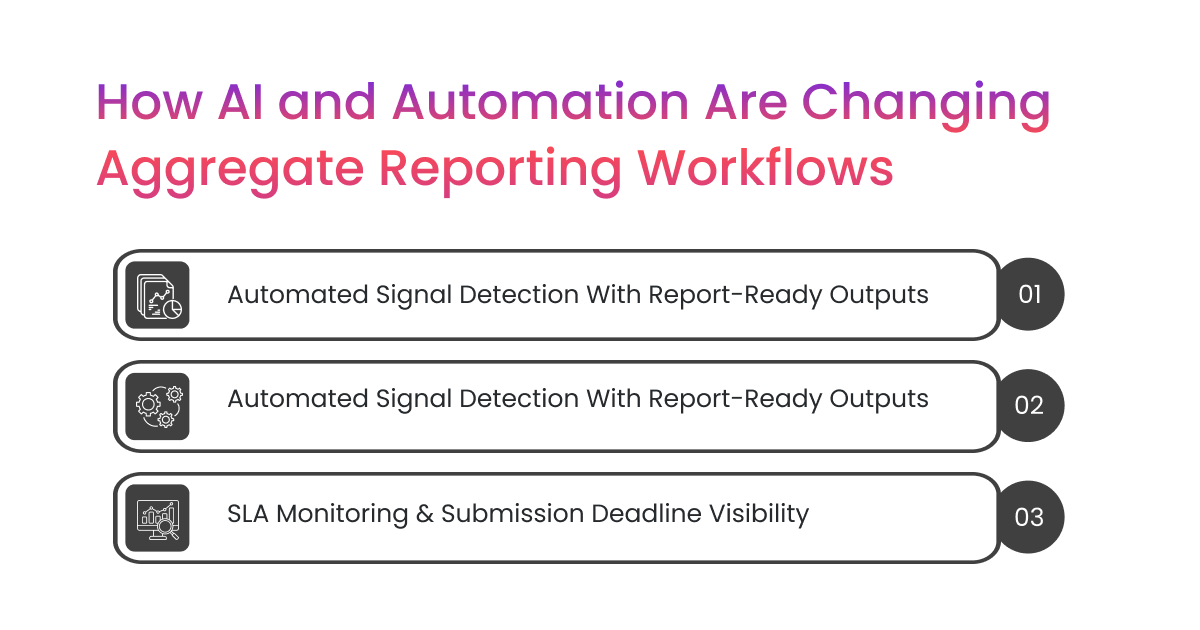
Automated Signal Detection With Report-Ready Outputs
Traditional signal detection operates on a batch review cycle: safety scientists export data from FAERS and EVDAS on a periodic basis, run disproportionality analyses using Proportional Reporting Ratio (PRR) or Reporting Odds Ratio (ROR) methods, and review outputs before compiling a summary for the PBRER. This approach creates a structural lag. When the data lock point arrives, signal analysis may already be several weeks behind current case activity.
Automated signal detection runs disproportionality analyses continuously, flagging new signals as they meet predefined thresholds without waiting for a quarterly review window. Crucially, a well-integrated system pre-formats signal outputs in a structure directly compatible with the PBRER’s signal summary section: validated signals, closed signals, and signals under evaluation, each with supporting case counts and date-stamped review records. This eliminates a significant manual compilation step before the data lock point.
A 2025 systematic review published in the International Journal of Clinical Pharmacy, covering a literature search conducted in January 2025 across PubMed, Scopus, and Web of Science, found that AI-based signal detection techniques have materially expedited safety signal identification in pharmacovigilance, with data mining and automated disproportionality analysis the most consistently validated applications.
Integrated Data Aggregation Across Case Sources
A PBRER draws on ICSR data from at least three distinct sources:
- Spontaneous reports from post-marketing surveillance
- Validation documentation demonstrating that the system performs within defined parameters
- Cases from ongoing or completed clinical trials.
In most legacy environments, these data streams exist in separate systems. Pulling them into a unified view before the data lock point requires manual exports, format conversions, and deduplication checks, each of which introduces error risk.
An integrated pharmacovigilance database eliminates this by consolidating spontaneous case data, literature-sourced ICSRs, and signal outputs into a single operational environment. When literature-identified cases are transferred directly into the safety database via API, without manual re-entry, they carry full audit trails connecting the source publication to the case record. This means that when the medical writer begins building cumulative case counts and line listings for the PBRER, the underlying data is already reconciled, coded, and traceable.
SLA Monitoring and Submission Deadline Visibility
The EMA’s EURD list governs not just whether a product requires a PBRER, but when the data lock point falls and when the submission is due. For companies with multiple products at different lifecycle stages, each on separate EURD cycles, managing these schedules via shared calendars creates compliance risks.
Automated SLA monitoring embedded within the pharmacovigilance platform tracks submission deadlines across the product portfolio, triggers alerts before windows close, and flags overdue tasks to the responsible team members. More importantly, it maintains a real-time record of which cases have been processed, which signals have been reviewed, and which sections of the PBRER preparation workflow are behind schedule, giving compliance leads visibility before the deadline rather than during the sprint toward it.
What Regulators Actually Expect When AI Is Involved
In January 2026, the FDA and EMA jointly released the Guiding Principles of Good AI Practice in Drug Development, a set of 10 high-level principles covering the responsible use of AI across the medicines lifecycle. While the principles are currently non-binding, both agencies have signaled they will underpin future formal guidance in their respective jurisdictions.
Several of the 10 principles apply directly to AI use in pharmacovigilance workflows, including aggregate reporting. Three are particularly relevant to how PV teams should be thinking about AI-assisted signal detection and data aggregation:
- Risk-based performance assessment (Principle 8) requires that AI systems be evaluated in the context of how humans actually interact with their outputs in real workflows. Validation datasets and performance measures must match the AI's stated purpose. For signal detection, this means testing how the system performs specifically on pharmacovigilance data, not just on general benchmarks.
- Life cycle management (Principle 9) requires quality management systems that govern AI from development through deployment, including ongoing monitoring for data drift and periodic re-evaluation. An automated signal detection tool that was validated at go-live but never monitored afterward does not meet this expectation.
- Data governance and documentation (Principle 6) requires that data sources, processing steps, and analytical choices be documented in a transparent, traceable, and verifiable way. In a pharmacovigilance context, this connects directly to the audit trail requirements that already exist under 21 CFR Part 11 and EU GMP Annex 11, which independently require that electronic records be attributable, tamper-evident, and retrievable on demand. The joint principles reinforce the expectation that AI-assisted steps must fit within that existing documentation framework, not sit outside it.
The joint principles make it clear that they apply across the full chain of parties involved: sponsors, CROs, software vendors, and other partners. This matters for aggregate reporting specifically. If an automated signal detection platform generates the outputs that feed into a PBRER signal summary, the MAH remains responsible for ensuring that the platform meets applicable validation and documentation standards; the accountability does not transfer to the technology vendor.
For teams using automated signal detection and data aggregation as part of their aggregate reporting workflow, it means the platform architecture matters as much as the analytical output. Systems that generate discrete audit records for every data pull, every signal review decision, and every case transfer into the safety database are better positioned for regulatory scrutiny than those that rely on documentation assembled separately before an inspection.
Is Switching to Automation-Supported PBRER Workflows Worth It for Mid-Sized Pharma?
The operational calculus differs by portfolio size and inspection history, but the directional case for automation in aggregate reporting is consistent across company sizes. The question for mid-sized companies is usually not whether to automate, but which parts of the workflow deliver the highest compliance return with the lowest implementation risk.
Three factors make aggregate reporting automation particularly relevant for mid-sized operations:
- Portfolio growth multiplies the reporting burden non-linearly. Adding three new products in different therapeutic areas may add five or six new PBRER cycles per year, each on separate EURD schedules. Manual workflow management does not scale proportionally.
- Cross-jurisdiction reporting creates data consistency pressure. A product approved in the EU, UK, and Japan simultaneously generates three regulatory obligations with overlapping but not identical data requirements. Without an integrated database, reconciling case data across these submissions is manual, time-consuming, and error-prone.
- Inspection readiness is a continuous requirement, not a periodic one. MHRA and EMA inspections can be triggered at any point in the PBRER cycle, not just at submission. Teams relying on manually assembled evidence are more exposed than those whose documentation is generated as part of normal operations.
The most effective entry point for mid-sized teams is typically the data infrastructure layer: automating signal detection outputs, integrating the safety database to eliminate cross-system exports, and deploying SLA monitoring before building out more advanced analytics. These changes materially reduce the preparation burden per PBRER cycle without requiring wholesale platform replacement.
How Clinevo's Pharmacovigilance Suite Supports Aggregate Reporting
Clinevo’s pharmacovigilance platform Clinevo’s pharmacovigilance platform is built around the principle that compliance and operational efficiency are not trade-offs.
The Safety Database and Signal Detection modules within Clinevo OnePV are automation-based systems designed to address upstream data challenges that determine the quality of PBRER and PSUR.
The table below summarizes how automation across these modules maps to specific aggregate reporting requirements:
| Capability Area | Manual Workflow | Automation-Supported Workflow |
|---|---|---|
| Signal detection to report | Quarterly batch review of FAERS and EVDAS exports; signals may lag 8 to 12 weeks behind case activity | Automated disproportionality runs (PRR, ROR) triggered continuously; signal outputs pre-formatted for PBRER sections |
| Data aggregation | Cross-system exports and manual reconciliation before the data lock point | Integrated safety database pulls case data, literature ICSRs, and signal outputs into a unified view |
| SLA and deadline tracking | Shared calendars and spreadsheets; relies on individual follow-up | Automated EURD-schedule tracking; alerts triggered before submission windows close |
| Audit trail for inspections | Manually assembled from emails, shared drives, and database exports | Tamper-evident, timestamped records generated continuously across case processing, signal detection, and submission |
Safety Database
Clinevo’s Safety Databasecase intake case intake processing, signal feed integration, and E2B R3-compliant ICSR management. For aggregate reporting specifically, this means:
- Case data from spontaneous reports, literature-sourced ICSRs, and clinical trial safety data are consolidated in a single system, with MedDRA coding applied consistently throughout the case lifecycle.
- Automated deduplication logic flags potential duplicate cases before they enter the case count, preventing inflated cumulative exposure figures that would otherwise distort PBRER line listings.
- Audit trails are generated continuously as part of normal case processing operations. Every review decision, every field edit, and every case transfer carries a timestamped, tamper-evident record that is retrievable on demand, without pre-inspection assembly.
- Real-time dashboards surface SLA status, case processing throughput, and submission compliance across the product portfolio, giving compliance leads visibility into potential deadline risks before they escalate.
Signal Detection
Clinevo’s Signal Detection module runs automated disproportionality analysis across FAERS, EVDAS, and internal case data, continuously evaluating PRR and ROR outputs against predefined thresholds. For aggregate reporting teams, this delivers:
- Signal outputs are organized by validation status, product, and reporting period, in a format directly compatible with the signal summary sections required in PBRER submissions.
- Trend analysis across signal categories, allowing safety scientists to identify patterns emerging within the current reporting interval rather than discovering them during the PBRER drafting phase.
- Documented review records for every signal assessment decision, providing the traceability that inspectors expect when evaluating how signals progressed from detection through evaluation to regulatory action or closure.
The platform integrates directly with Argus Safety, ArisGlobal, and Clinevo Safety databases connecting pharmacovigilance case data to signal management outputs within a single operational environment. Both modules are compliant with 21 CFR Part 11, EU GMP Annex 11, GxP, and GDPR requirements, with compliance built into the system architecture rather than added as a configuration layer.